Thypoch Summer Sale 2026 Starts June 15
Thypoch Summer Sale 2026 runs June 15 to July 31 with up to 20% off selected lenses, plus 5% extra with code LEICALENSLIST.
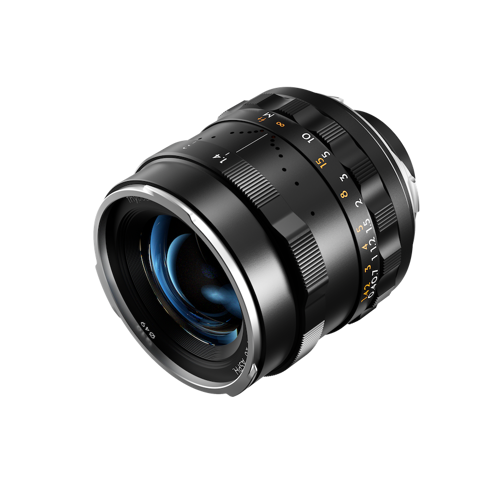
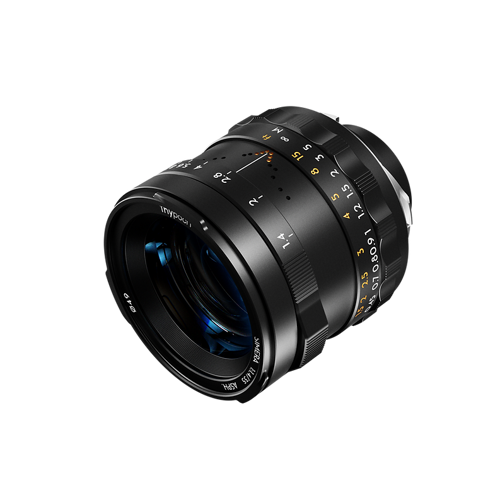
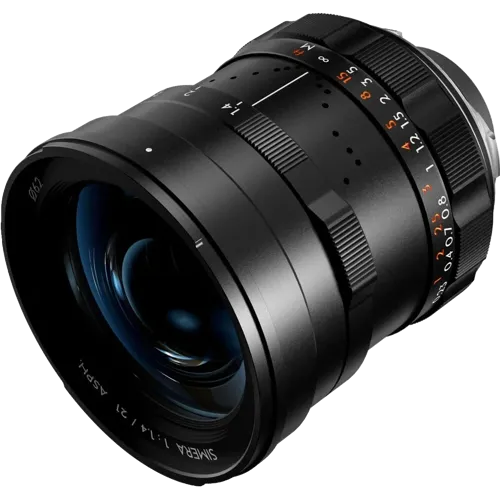
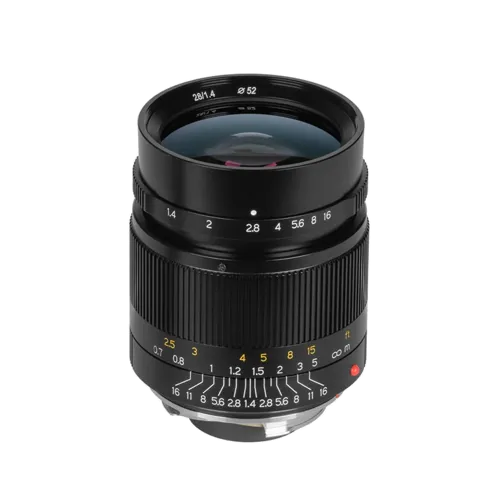
The Thypoch Simera 28mm f/1.4 is a fast wide-angle M-mount lens with a floating-element design, 14 rounded blades, and rangefinder coupling prized for its bokeh.
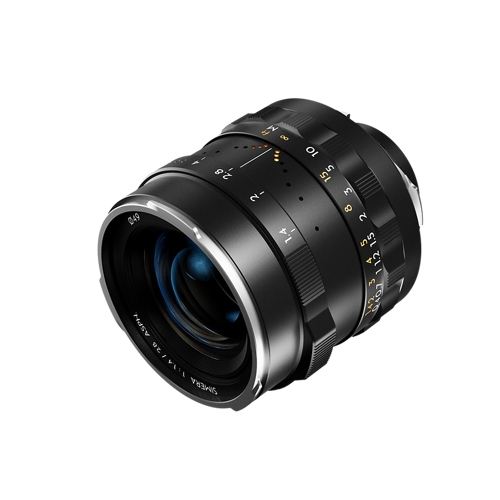
M mount
No listings tracked for this lens right now.
The Thypoch Simera 28mm f/1.4 is a M-mount lens for Leica rangefinder cameras. Leica price index →
Measured against the 37 other 28mm M-mount lenses in the catalogue.
Among the small group of fast 28mm lenses made for the Leica M mount, the Simera 28mm f/1.4 arrived as one of the first products from Thypoch, a Chinese optics maker that entered the market at the end of 2023 alongside a companion Simera 35mm f/1.4 [1][2]. Reviewers singled it out because genuinely fast 28mm rangefinder lenses are uncommon and difficult to design, and because the Simera competed directly on rendering with much larger and far more expensive alternatives such as the Leica Summilux-M 28mm and the Voigtländer Nokton 28mm.
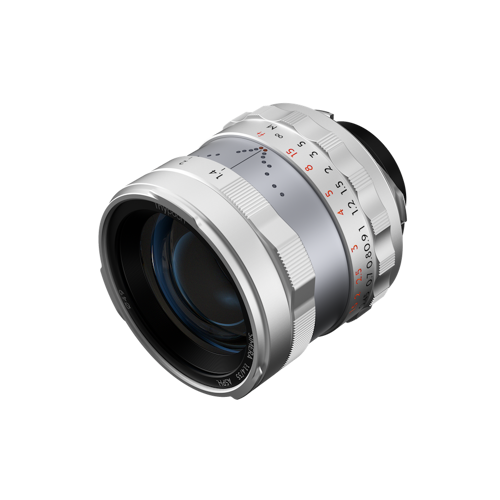
The optical formula uses 11 elements in 7 groups and incorporates a floating-element design that helps maintain image quality across the focus range down to the 0.4 m minimum focus distance. The lens is rangefinder coupled, with a distinct click stop at 0.7 m that marks the edge of the coupled range, and it is built to a high mechanical standard from metal with engraved, paint-filled markings. The aperture uses 14 rounded blades, an unusual choice that keeps out-of-focus highlights round when stopped down while still producing defined sunstars at smaller apertures. Handling, however, drew criticism: the depth-of-field display takes up space and leaves a narrow focus ring set close to the camera body, the focus throw at close distances is very short, the aperture click spacing is irregular, and an infinity lock similar to those on older Leica lenses was widely disliked. A shiny front ring, like those on some Voigtländer lenses, can contribute to flare.
A notable feature is the depth-of-field scale, which revives the "Visifocus" system Alpa introduced in 1951: instead of plain lines, red dots light up as the aperture is changed. The lens is offered in black and silver finishes. Thypoch later expanded the Simera line to other mounts including Canon RF, Nikon Z, Sony E and Fujifilm X, and the M-mount original was followed by a revised focus-tab version; according to the lens designer, no optical adjustment was made for the thicker filter stacks of mirrorless cameras, so the lens is optimized for the thin filter stack of Leica bodies and performs best there.
Rendering The Simera 28mm f/1.4 is described as a modern rendering lens with strong contrast already at f/1.4, smooth transitions and pleasing, almost medium-format-like separation. Reviewers rated its bokeh as the best among the fast 28mm M-mount lenses tested, helped by relatively low optical vignetting and well-corrected field curvature.
Sharpness On a Leica M10 the lens shows very good sharpness across the frame, with only a hint of a midzone dip and slightly lower corner contrast at f/1.4 and f/2.0; best across-frame performance falls between roughly f/5.6 and f/8.0. Center sharpness is high at all apertures, and the corners clean up from about f/4. It does not show field-relevant focus shift on stopping down.
Bokeh and transitions The 14 rounded blades keep highlights round when stopped down, and the combination of low optical vignetting and corrected field curvature yields smooth backgrounds at both close and longer distances. The short 0.4 m minimum focus allows close-up shots with softly blurred backgrounds.
Flare resistance Flare resistance was rated only average. With a strong point light source the lens can show various artifacts, and sensor reflections were noted, which the reviewer suggested may relate to the rear-element coating; the shiny front ring can add unwanted flare.
Distortion and vignetting Distortion is low and slightly wavy. Light falloff is typical for a fast, compact 28mm M-mount lens, measured at about 3.2 EV wide open and dropping to roughly 1.9 EV stopped down.
Aberrations Coma is noticeable at f/1.4 but the artifacts are comparatively small; stopping to f/2.0 removes the "wings," with fully clean corners by about f/5.6. Lateral chromatic aberration is minimal, while longitudinal CA (bokeh fringing) is around average and is not fully eliminated by f/2.0.
Digital use Because the optics are tuned for the thin Leica filter stack, performance on cameras with thicker filter stacks such as Sony E bodies is weaker, particularly in the outer field; the Visifocus depth-of-field scale is also noted as too imprecise to be relied on with high-resolution digital sensors.
Development and Launch Thypoch launched as a new lens manufacturer at the end of 2023 with two M-mount lenses, the Simera 28mm f/1.4 and the Simera 35mm f/1.4. The 28mm uses an original 11-element, 7-group formula that reviewers could not match to an existing design, taken as evidence the maker was engineering rather than copying. A pre-production sample circulated in early 2024 did not fully meet the maker's expectations, and a final production loaner followed in April 2024.
Production Evolution Thypoch addressed an early fitment problem: a very early pre-production sample would not mount on a Leica M6, an issue attributed to that sample's quality control and reported as resolved on final production units, which fit film M bodies. The Simera family was later expanded beyond M mount to Canon RF, Nikon Z, Sony E and Fujifilm X, and the line evolved away from its self-engaging infinity-lock arrangement toward a thumb-rest style focus tab on later models.
Collector Notes Buyers should verify rangefinder calibration: at least one user reported a copy whose infinity hard stop and focusing scale were significantly off against the rangefinder, underscoring the value of checking focus accuracy before purchase. The infinity lock and the narrow, low-set focus ring are recurring complaints, so handling preference is worth confirming in person. The lens is not six-bit coded; users adding their own coding should note that, unlike some Voigtländer mounts with a recessed groove, this point was raised but left unconfirmed in discussion. The shiny front ring and average flare control are worth keeping in mind for backlit work. Filters use a 49 mm thread.
Similar lenses you might be interested in

Thypoch Summer Sale 2026 runs June 15 to July 31 with up to 20% off selected lenses, plus 5% extra with code LEICALENSLIST.
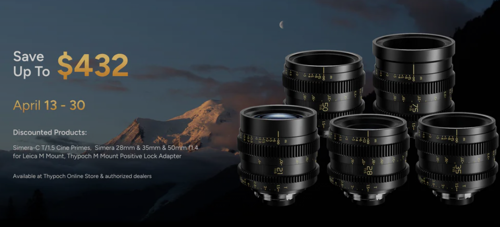
Thypoch Spring Sale 2026 is live: save on Simera 28, 35 and 50mm M-mount lenses, plus get an extra 5% off with code LEICALENSLIST.

Black Friday is coming. Thypoch offers a nice discount on their offerings!
Comments