The Solinon Optik 18mm f/5.6 ASPH is a compact Hong Kong-designed ultra-wide M-mount lens, the first product from a one-person Chinese-made startup.
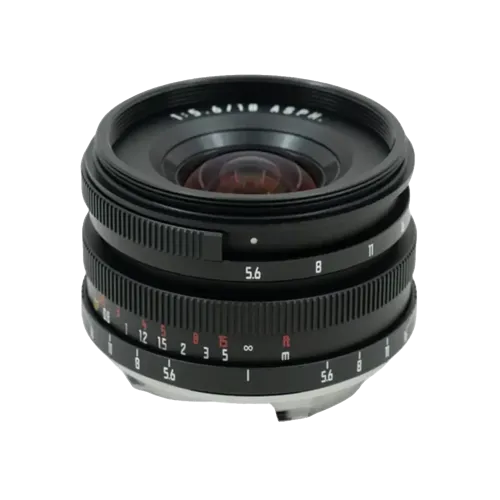
Solinon Optik 18mm f/5.6 ASPH
M mount
No listings tracked for this lens right now.
The Solinon Optik 18mm f/5.6 ASPH is a M-mount lens for Leica rangefinder cameras. Leica price index →
Specification
About this lens
Solinon Optik 18mm f/5.6 ASPH
The 18mm f/5.6 ASPH is the debut product of Solinon Optik, a small venture founded by Calvin Lee, a Hong Kong-based manual-focus lens collector who worked in the back office of a Leica specialist dealer and developed the lens in his spare time over roughly two years [2]. Lee handled the housing and specification while an experienced aspherical-lens designer worked on the optics, and the lens was manufactured in China. The name itself reflects his background as a collector: "sol" is Latin for sun, while "inon" is taken from the Quinon line of the German maker Steinheil. His stated motive was that Leica and Zeiss no longer make an M-mount 18mm, that the older designs were bulky and expensive, and that a modern aspherical formula could better resolve the demands of high-resolution sensors. The lens reached the market in early 2025 and was announced as a new Chinese lens company's first rangefinder lens [3].
The optical formula uses nine elements in seven groups, including two aspherical elements and two extra-low-dispersion elements with multi-coating, in a body that stays compact and light for the class. Build quality is consistently described as very good, with engraved, paint-filled barrel markings whose colours resemble Cosina's Voigtländer VM lenses, a focus ring that travels about 120 degrees from the 0.38 m minimum focus distance to infinity, and an aperture ring with equidistant half-stop clicks [1]. The five straight aperture blades are typical of a lens at this focal length. On a Leica body the lens brings up the 28/90 mm frameline pair and causes significant rangefinder window blockage, so an external finder or live view is the practical way to compose; the supplied rectangular metal screw-on hood has a cut-out to reduce that blockage and aligns precisely. As an M-mount lens it adapts readily to mirrorless cameras.
Being a new and single-variant lens, there are no documented version, coating, mount, or finish variations; it is sold in black and ships from Hong Kong with the metal hood and a slip-on cap, typically at a price around 444 US dollars.
Optical qualities
Rendering Reviewers describe the lens as a genuine high performer despite its modest maximum aperture. It is sharp and even across the frame, shows very low distortion, controls chromatic aberration well, and produces distinct sunstars, with vignetting and coma rated as merely average rather than poor.
Sharpness On a 24 MP Leica M10 the lens shows an even, very good across-frame result from its maximum aperture of f/5.6, which is important for a lens that cannot be opened wider. Phillip Reeve's review notes that competing wides such as the Zeiss ZM 18mm f/4.0 and the Voigtländer VM 15mm f/4.5 II need to be stopped to f/8.0 to match what the Solinon delivers at f/5.6. A field reviewer shooting a 60 MP Leica M11 also found it more than sharp enough at the pixel level.
Distortion and vignetting Distortion is described as barely present, an advantage on both film and digital and one of the maker's design goals. Light falloff measures about 2.2 EV in the corners at all apertures, which is higher than ideal but lower than several compact rivals and comparable to the larger Zeiss ZM 18mm f/4.0.
Flare resistance Flare resistance is rated as good, and a field reviewer reported no serious flare problems across varied real-world shooting, noting only an occasional minor flare spot in backlit conditions.
Aberrations Lateral chromatic aberration was not observed, and longitudinal CA is negligible given how wide and slow the lens is. Coma is low at f/5.6 and effectively gone by f/8.0.
Digital use The lens performs well on modern high-resolution M bodies, and its low distortion avoids the software corrections that can soften edges on some ultra-wides. Because it is a new design rather than a film-era optic, it is not associated with the heavy corner colour casts seen on older wides used on digital sensors.
History
Development and Launch The lens was conceived by Calvin Lee of Hong Kong, a long-time collector of mainly German and Japanese lenses, who set out to create an 18mm M-mount lens that was small, affordable, and optimised for current sensors after concluding that no existing option met those goals. He defined the housing and specifications himself and commissioned the optical design from an experienced lens designer, with production in China. It was reviewed in February 2025 and reported as a new company's first lens in March 2025.
Collector Notes Because the lens is recent and produced in a single configuration, originality and conversion concerns common to vintage glass do not yet apply. One point worth flagging is rangefinder coupling: this listing records the lens as not rangefinder coupled, while published reviews describe a working coupling, with one tester reporting accurate coupling and another stating it is mechanically coupled to about 0.9 m and focuses uncoupled to 0.38 m. Buyers who rely on coupling should confirm the behaviour of a given copy. The lens is not factory six-bit coded; at least one owner added his own coding. Accessories to verify on a used purchase are the matching rectangular metal hood and slip-on cap, the latter noted to detach easily, and the lens accepts common 46 mm filters.
Sources
Where to buy
Related lenses
Similar lenses you might be interested in

Comments