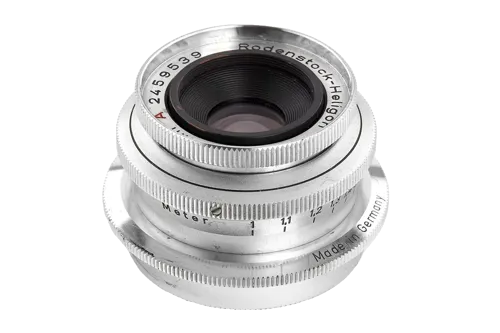
A 1951 German 35mm f/2.8 wide-angle with six elements in four groups, coupled Leica M39 focusing, 1m close focus and an A36 fitting.
Rodenstock Heligon 35mm f/2.8
LTM mount
No listings tracked for this lens right now.
The Rodenstock Heligon 35mm f/2.8 is a LTM-mount lens for Leica rangefinder cameras. Leica price index →
How it compares
Measured against the 45 other 35mm LTM-mount lenses in the catalogue.
Specification
About this lens
Rodenstock Heligon 35mm f/2.8
The Rodenstock Heligon 35mm f/2.8 is a German wide-angle lens made in 1951 for Leica screw-mount rangefinder cameras. Contemporary surviving examples are engraved Heligon A, and Leitz Auction documents the lens in an original rangefinder-coupled M39 mount. The recorded optical construction is six elements in four groups. It focuses to 1 metre and uses an A36 accessory fitting, giving it the compact handling expected of an early post-war 35mm lens.
Optical qualities
Rendering
On 35mm film, a 35mm focal length gives a moderately wider view than a standard lens without the strongly expanded perspective of shorter wide angles. It is suitable for street scenes, interiors, travel and environmental portraits. Perspective still depends on camera position: the lens includes more of the scene, while moving very close to a subject creates the apparent exaggeration often attributed incorrectly to focal length alone.
At wider apertures
At f/2.8, the lens is fast enough for general available-light work by the standards of its period. Depth of field remains greater than it would be with a 50mm or 85mm lens framed from the same position, yet careful rangefinder focusing is still important at short distances. The 1m minimum focus limits close subject isolation compared with modern 35mm lenses that focus much nearer.
Stopped down
The middle apertures provide more depth of field and ordinarily reduce the visible effect of several residual aberrations. For architecture or layered street scenes, stopping down also makes scale-focusing more practical. Edge behaviour should be checked on a flat, detailed subject because film flatness, adapter alignment and lens decentring can otherwise be mistaken for an optical limitation.
Handling and compatibility
The original M39 mount communicates subject distance mechanically to a compatible rangefinder body. That coupling is distinct from the screw thread itself: other M39 lenses may share the thread while lacking the correct cam or register. A cleanly calibrated Heligon should reach infinity and agree with the rangefinder over its focusing travel, including the 1m near limit.
History
Development and Launch
Rodenstock was founded by Josef Rodenstock in 1877 and developed into a major German optical company. Its official history concentrates on ophthalmic milestones, while the photographic Heligon range represents a separate part of its twentieth-century output. The 1951 manufacture date recorded by Leitz Auction places this 35mm lens in the early post-war expansion of interchangeable rangefinder optics.
A 35mm lens complemented the standard 50mm field without requiring the very short focal lengths that were harder to correct and frame on rangefinder cameras. The f/2.8 aperture balanced speed and size. The consulted records do not establish an exact announcement date, original catalogue price or named designer for the Leica-thread version.
Production Evolution
Leitz Auction documents a 1951 Heligon A in original coupled M39 mount. The Lens DB record supplies the six-element, four-group specification and 1m focusing limit used in this profile. These sources establish the configuration but do not provide a complete production interval or total.
No verified evidence has been found for multiple optical generations within the coupled M39 35mm f/2.8 model. Differences in engraving, focusing scale, finish or accessory provision may reflect market destination or production detail. They should be recorded, but not automatically interpreted as revised formulas. Likewise, an example mounted by a third party does not define a factory version.
Special Editions/Variants
The letter A appears in documented engraving and auction naming. In the absence of a factory explanation, it is best treated as part of this model's designation rather than decoded speculatively. The database title omits the letter for brevity, but the profile retains it as an identification point.
Other Heligon lenses may share the family name while differing in focal length, aperture, camera system and optical construction. They remain separate products. No commemorative or limited cosmetic edition of this exact 35mm M39 lens is documented in the consulted sources. A hood, finder, case or rear cap is an accessory set, not a special optical variant.
Collector Notes
Identification should combine the Rodenstock and Heligon A engraving with the 35mm f/2.8 specification, original Leica thread and functional rangefinder cam. The 1m minimum focus and A36 front are useful secondary checks. Because adaptations can be well made, a thread that fits is not conclusive evidence of a factory M39 barrel.
Inspect the lens for coating damage, haze, fungus, separation and signs of decentring. Check that the aperture changes cleanly, the focus reaches both stops and the cam agrees with a known calibrated body. Wide-angle lenses can reveal tilt readily in corner tests, so a flat target and carefully aligned camera are preferable to an informal wall photograph. Auction condition, price and included accessories describe individual lots and are not properties of the model.
Sources
Where to buy
Related lenses
Similar lenses you might be interested in
Comments