A 1953 Japanese 85mm f/1.5 portrait lens with seven elements in three groups, original coupled LTM focus, 16 blades and 1.07m close focus.
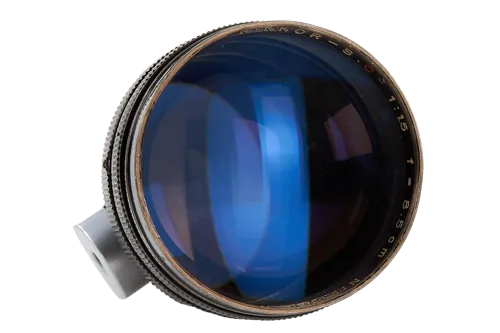
Nippon-Kogaku Nikkor-S.C 85mm f/1.5
LTM mount
No listings tracked for this lens right now.
The Nippon-Kogaku Nikkor-S.C 85mm f/1.5 is a LTM-mount lens for Leica rangefinder cameras. Leica price index →
How it compares
Measured against the 14 other 85mm LTM-mount lenses in the catalogue.
Specification
About this lens
Nippon-Kogaku Nikkor-S.C 85mm f/1.5
The Nippon-Kogaku Nikkor-S.C 85mm f/1.5 is a high-speed Japanese portrait lens produced for postwar rangefinder cameras. This profile covers the original factory Leica screw-mount version, with rangefinder coupling, a minimum focusing distance of approximately 3.5 feet or 1.07 metres, a 57mm filter thread and a sixteen-blade diaphragm. Nikon documents a seven-element, three-group Sonnar-type optical system.
The 8.5cm and 85mm notations describe the same nominal focal length. Native Nikon and Contax rangefinder versions are related products, but their mounts and focusing interfaces are not interchangeable with the LTM barrel represented here.
Optical qualities
Rendering
The seven elements are arranged in three groups with substantial cemented components, a classic way to obtain high speed in a relatively compact rangefinder telephoto. Nikon explains that the Sonnar-type power distribution also behaves as a telephoto arrangement. The result is smaller than a comparable fast double-Gauss lens might be, although the f/1.5 glass and focusing barrel still make it a substantial rangefinder optic.
Nikon's optical history describes visible flare and a mild, finely graduated image at or near maximum aperture. It also notes that aberration changes become stronger at close distance, where the image grows softer and flare increases. These observations concern the design and Nikon's test lens. Haze, separation and coating damage can add a different, condition-related loss of contrast.
At f/1.5
At portrait distance, the 85mm focal length and f/1.5 aperture provide shallow depth of field and strong separation from a distant background. Precise rangefinder calibration is important because a small focusing error is readily visible. The 1.07m near limit is useful for tight portraits but is also the distance at which Nikon says the Sonnar design's close-range aberration change is most pronounced.
The sixteen-blade iris keeps the aperture opening relatively rounded as the lens is stopped down. Background structure still depends on subject geometry, focus distance and highlight placement, so the blade count does not guarantee a single bokeh character in every scene.
Stopped down
Nikon reports that flare clears and sharpness rises around f/2 to f/2.8. By f/5.6 to f/8, the lens produces a sharper, higher-contrast image suited to subjects requiring more depth and field consistency. Diffraction eventually limits fine detail at the smallest settings. A hood can support contrast, particularly when strong light falls across the large front element.
Handling and compatibility
The coupled LTM focusing mount should agree with a calibrated Leica-thread rangefinder from infinity through its normal travel. On a Leica M body, an appropriate M39-to-M adapter supplies the bayonet interface but cannot correct a misadjusted cam. Mirrorless use allows direct sensor focusing. The 57mm front and dense construction should be supported carefully rather than allowing the lens to hang loosely from a worn adapter.
History
Development and Launch
Nikon names Saburo Murakami as the designer of the first trial layout, dated July 1950. Zenji Wakimoto then continued the work, and Nikon records eight sets of drawings and seven trial optical systems between 1950 and 1952. The final lens debuted after approximately two years of development.
Leitz Auction documents an original coupled M39 example from 1953. That date is consistent with Nikon's early-1950s account and supports the factory status of the Leica-thread barrel. No exact LTM announcement month or original list price is given in the consulted sources.
Production Evolution
The model appeared in more than one native rangefinder mount. Engraving, scale and finish details vary between surviving examples, while the model-defining optical identity remains the 8.5cm f/1.5 Sonnar type. A complete factory chronology for every LTM exterior variation has not been located.
Nikon's wider rangefinder history places the fast 85mm among the lenses introduced from 1952 to 1954. Production quantities sometimes quoted by dealers or collectors are not used here because no factory ledger has been verified.
Special Editions/Variants
Black-and-chrome and black-painted presentations are documented, as are Nikon and Contax rangefinder barrels. These should be described as finish or native-mount variants, not as proof of a different optical formula. A lens head installed later in an M39 focusing mount is an adaptation and remains distinct from a factory-coupled LTM example.
Collector Notes
Check the Nikkor-S.C and 8.5cm f/1.5 engraving, the original Leica thread, rangefinder cam, 57mm filter fitting and operation of all sixteen aperture blades. The heavy optical unit makes play in the helicoid or mount especially relevant. A full-aperture test should be made at several distances to distinguish normal close-range behaviour from miscalibration.
Large cemented groups deserve careful inspection for separation, haze and fungus. Cleaning marks and coating loss may increase flare beyond Nikon's design description. Auction condition, included cases and sale prices belong to individual examples and should not be treated as general specifications.
Sources
Where to buy
Related lenses
Similar lenses you might be interested in
Comments