Best price New
MS Optics Fluorit Super Apochromat Aporis 135mm f/2.4 Full MC
Sold by Japan Exposures
€737 ≈ $796
The MS-Optics Aporis 135mm f/2.4 is a compact fluorite super-apochromat for Leica M mount, a collector favorite from one-man maker Sadayasu Miyazaki.
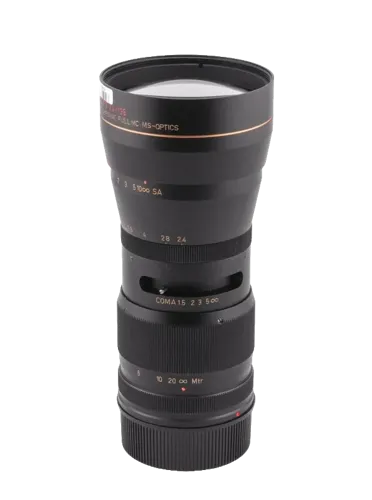
M mount
The MS-Optics Aporis 135mm f/2.4 is a M-mount lens for Leica rangefinder cameras. As of October 2026, it sells from €737 used across 1 listing, with a 30-day median of €737. Leica price index →
Measured against the 8 other 135mm M-mount lenses in the catalogue.
The Aporis 135mm f/2.4 stands out as the longest and most ambitious lens to come from MS-Optics, the one-person workshop of Sadayasu Miyazaki in Japan, who is better known for tiny wide-angle and standard pancakes for the Leica M [1][2]. Where most of his designs are character lenses with deliberately retained spherical aberration, the Aporis carries an apochromatic ambition: it is built around a calcium-fluoride (CaF2) fluorite element of the type Canon uses in its super-telephotos to suppress chromatic aberration, supplied by Canon Optron[3]. The result is an unusually fast 135mm that remains light at 360 g, a combination that drew strong interest from collectors and adapter-using mirrorless photographers when it appeared.
Miyazaki used an Ernostar-derived optical layout for the lens, and the barrel is hand-assembled anodized aluminium in black. Handling is distinctive. The focus ring is effectively the whole front barrel in a unit-focus design, so the aperture ring and front element rotate while focusing, and the lens extends as it focuses closer; the aperture ring itself is clickless, and the 16 rounded blades keep out-of-focus highlights round well into the stopped-down range. Two further rings allow the user to adjust spherical aberration and coma, with the SA adjustment changing the spacing of the front element to trade field flatness against bokeh smoothness. On the verified M-mount version recorded here the lens is not rangefinder-coupled, which suits live-view and mirrorless use.
At launch two configurations were offered: a rangefinder-coupled version sold with a 1.8x eyepiece magnifier, and an uncoupled version intended for mirrorless and live-view bodies that carried the spherical-aberration and coma adjustment levers. Production is in very small hand-made batches, with new copies distributed mainly through Japan Camera Hunter and similar specialist channels, so the lens trades infrequently and largely on the used market. Buyers should note that early pre-release figures and some retailer listings differ from the production lens; one vendor page describes a six-element Ernostar and lists a 1.6 m minimum focus distance, whereas the confirmed configuration here is a five-element, five-group design focusing to 1.3 m.
Rendering The Aporis is designed for high contrast across the frame from f/2.4, with apochromatic correction that, while not as complete as the best modern apo designs, controls longitudinal color aberration very well for such a small, simple lens. Its rendering can be tuned by the SA adjustment ring, shifting from a flatter, harsher look to smoother bokeh and even pronounced glow at the extreme settings.
Sharpness Resolution depends on the SA setting. With the ring set for minimal field curvature the lens is fairly soft across the frame wide open, needing roughly f/4 for a strong center and f/8 to f/11 for the corners; a softer SA setting lifts center and midframe performance about a stop at the cost of field flatness. Corners never reach the resolution of larger modern 135mm designs, in part because the image circle is optimized to about 40 mm rather than the full 43.3 mm diagonal.
Bokeh and transitions Bokeh is a focus of the design. The 16 rounded blades keep highlights round even stopped down, mechanical vignetting (cat's-eye) is moderate, and the adjustable spherical aberration lets the user choose between smooth and more classic, outlined rendering.
Contrast and color Contrast is high even wide open, and the fluorite element gives good color correction with only very minor lateral chromatic aberration that is easily removed in software.
Flare resistance Like many fast telephotos, the Aporis loses contrast against strong backlight, and a point light source near a corner can produce noticeable veiling flare; the small screw-in metal hood offers limited help in worst cases.
Distortion and vignetting Distortion is negligible pincushion with no practical relevance. Vignetting is about 1.5 EV wide open, falling to roughly 0.9 EV at f/2.8 and becoming insignificant from f/4.
Development and Launch MS-Optics is named for its founder Sadayasu Miyazaki, who specialized in very small M-mount lenses. The Aporis was first detailed publicly in early 2017 as his next M-mount project and his first long-focus lens, described as an Ernostar-type fluorite super-apochromat using fluorite supplied by Canon Optron, with dual coma and spherical-aberration adjustment levers. Miyazaki has explained that he turned to fluorite after concluding that a fast 135mm benefits most from such glass, designing toward a very low refractive index and an Ernostar form to keep coma low while reaching f/2.4.
Special editions No major factory special editions are widely documented. The principal variants are the rangefinder-coupled and uncoupled versions offered at introduction, the latter carrying the SA and coma adjustment levers.
Collector Notes The Aporis is sold in small, hand-made quantities and appears on the used market only occasionally, so condition and originality should be checked carefully. Because focusing rotates the front barrel and element, the lens is awkward with polarizers, and prospective buyers should confirm the SA and coma rings move smoothly and that the front element assembly is correctly seated. Pre-launch and retailer specifications vary, including differing element counts and a 1.6 m minimum focus figure, so verifying the actual configuration of a given copy is worthwhile; the lens uses 58 mm filters and ships with a small screw-in metal hood worth confirming as present.
About the usual price. The lowest listing is around the 30-day average.
Over the last 2 weeks the median price for the MS-Optics Aporis 135mm f/2.4 has risen, ranging from €715 to €737 (now €737).
Weekly price (EUR). Median (Good or better) and lowest (Good or better) across 2 weeks. The full figures follow in the table below.
| Week | Median | Lowest |
|---|---|---|
| Jul 27, 2026 | €715 | €715 |
| Oct 5, 2026 | €737 | €737 |
Every shop grades differently. Leica Classic uses letters, Ffordes uses E++ and E+, German dealers write "Zustand B", Japanese dealers write A−. We map all of them onto the one ladder below. Where a shop states its own grade, we print it under ours.
As of October 2026, the MS-Optics Aporis 135mm f/2.4 sells from €737 used, with a 30-day median of €737, across 1 active listing.
As of October 2026, the MS-Optics Aporis 135mm f/2.4 is sold by 1 source (1 listing), from €737 used: all compared cheapest-first on this page.
Similar lenses you might be interested in

Comments