Best price New
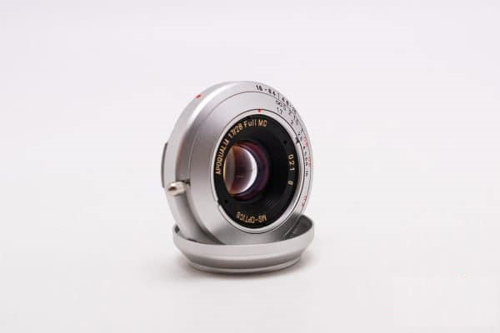
MS Apoqualia-G/Apolia-G 35/f1.4
Sold by japanexposures.com
€715 ≈ $773
The MS-Optics Apoqualia 35mm f/1.4 is a tiny hand-built Leica M double Gauss by Miyazaki Sadayasu, a sought-after collector lens.
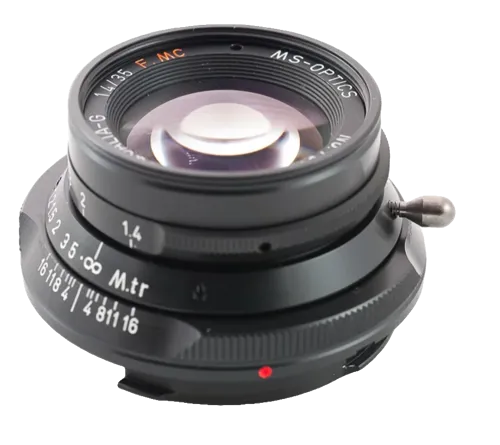
M mount
The MS-Optics Apoqualia 35mm f/1.4 is a M-mount lens for Leica rangefinder cameras. As of October 2026, it sells from €715 used across 1 listing, with a 30-day median of €715. Leica price index →
Measured against the 76 other 35mm M-mount lenses in the catalogue.
Weighing only 85 grams and barely longer than a bottle cap, this 35mm packs an f/1.4 maximum aperture into one of the smallest fast wide-angle lenses ever made for the Leica M mount. It is the work of Miyazaki Sadayasu, the optical designer behind MS-Optics (formerly MS-Optical R&D), a one-man Japanese workshop where formulas are still calculated by hand and elements are sourced from outside suppliers and assembled by Miyazaki himself [1]. The Apoqualia 35mm f/1.4 is a double Gauss design built from six spherical elements in four groups, with no aspherical surfaces, in keeping with the maker's emphasis on compactness rather than maximal aberration correction[2]. It reached the market in November 2015 and, with no current new supply, it has become something of a collector's item, with used prices well above its roughly 1,000 USD launch price.
Handling is unusual even by MS-Optics standards. The front barrel acts as the aperture ring, with a separate focus barrel behind it, so changing aperture while holding the lens can move both rings together unless the small focus lever is steadied; the aperture itself is clickless and runs through a non-equidistant scale of about 100 degrees from f/1.4 to f/16, while focus travels roughly 120 degrees to the 0.6 m minimum. The 12 rounded blades keep out-of-focus highlights natural, and the filter thread is reversed (male) at 37 mm, with an additional conventional 46 mm thread in the supplied metal hood, which can also be reverse-mounted. The lens is not rangefinder coupled and is small enough that it causes essentially no viewfinder blockage. Although a six-bit coding groove is present, it is cut too wide, so on digital Leica bodies stray light can reach the coding reader and cause the camera to misbehave; a small piece of tape is the usual fix.
A special edition with the same optics in a different casing, named Reiroal, was sold only through Map Camera in Japan. The lens was later joined and effectively succeeded by the collapsible MS-Optics Apoqualia 35mm f/1.3 II Slim, introduced in 2021.
Rendering The lens shows a clear split in character between its widest setting and the rest of its range. Wide open it produces a pronounced soft "glow" from undercorrected spherical aberration across the frame, lowering contrast and giving a dreamy look that some prefer for portraits or nature work; by f/2.0 most of that glow clears and the lens becomes noticeably crisper. Reviewers consistently describe it as more enjoyable used as a fast f/2 lens than at f/1.4.
Sharpness Center resolution is modest at f/1.4 due to spherical aberration but improves steadily on stopping down, looking decent by f/2.0 and very good from f/2.8 in the center; well-controlled astigmatism keeps usable resolution at portrait distances even wide open. The field is somewhat wavy, and corner performance benefits from stopping down to about f/11.
Bokeh and transitions At f/1.4 background point lights show outlining from the lens's spherical aberration behavior, and backgrounds can look busy; this outlining largely settles by f/2.0 over most of the frame, yielding a calmer rendering, with high optical vignetting affecting the corners.
Aberrations The "Apo" in the name is at least partly justified by very low longitudinal and lateral chromatic aberration, with only minimal color fringing in out-of-focus areas, which is notable for such a small, fast design. Coma, however, is strong at wide apertures and only clears well into the stopped-down range.
Flare resistance Despite multicoating on its elements, flare control is a weak point: strong light sources in the frame can produce prominent ghosting and some veiling flare, especially at f/1.4.
Distortion and vignetting Distortion is low and uniform, easily corrected if needed, while vignetting is high wide open at roughly three stops, dropping as the lens is stopped down, which is typical for so compact a fast 35mm.
Digital use The lens has been used successfully on both digital Leica M and adapted mirrorless bodies. On the thicker filter stack of a Sony body, mid-frame and corner results stopped down can actually look better than on the Leica M10, where the thinner stack reveals more field unevenness off-center.
Development and Launch MS-Optics is a small Japanese lens manufactory whose name comes from its founder, Miyazaki Sadayasu (born 1940), who serves as both head of the business and the designer of its lenses. The firm's lenses are distinguished by low element counts, hand-calculated optical formulas, the avoidance of aspherical glass, and a priority on extreme compactness over textbook correction. The Apoqualia 35mm f/1.4 fits this pattern as a tiny, very bright double Gauss, and it was first released in November 2015.
Special editions The only widely documented factory variant is the Reiroal edition, which shared the optical design but used a different barrel and was distributed exclusively through Map Camera.
Collector Notes Because new stock is effectively unavailable, the lens trades used and has appreciated since launch, so condition and originality matter to buyers. Prospective owners should be aware of the quirky two-barrel aperture-and-focus arrangement and the reversed filter thread, which limits filter and polarizer use to the lens hood's conventional 46 mm thread. The oversized six-bit groove can confuse digital Leica metering and live view, a known issue addressed with tape. At least one owner has also reported focus calibration and focus-shift behavior wide open and a somewhat flimsy-feeling aperture ring near f/1.4, so checking focus accuracy and ring feel before purchase is prudent. For European owners, the workshop Skyllaney Opto-Mechanics is noted as a service option for MS-Optics lenses.
About the usual price. The lowest listing is around the 30-day average.
Every shop grades differently. Leica Classic uses letters, Ffordes uses E++ and E+, German dealers write "Zustand B", Japanese dealers write A−. We map all of them onto the one ladder below. Where a shop states its own grade, we print it under ours.
As of October 2026, the MS-Optics Apoqualia 35mm f/1.4 sells from €715 used, with a 30-day median of €715, across 1 active listing.
As of October 2026, the MS-Optics Apoqualia 35mm f/1.4 is sold by 1 source (1 listing), from €715 used: all compared cheapest-first on this page.
Similar lenses you might be interested in
Comments