Best price
TRI-ELMAR-M 1:4/28-35-50mm ASPH. (Redes.)
Sold by classic.leica-camera.com
€3,330 ≈ $3,597
The Leica Tri-Elmar-M 28-35-50mm f/4 ASPH Type 2 (11625) is a compact three-focal-length M-mount lens, the collectible E49 successor to the original MATE.
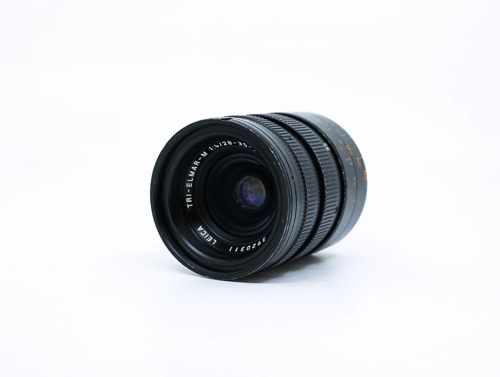
M mount
The Leica Tri-Elmar-M 28-35-50mm f/4 ASPH. Type 2 is a M-mount lens for Leica rangefinder cameras. As of October 2026, it sells from €3,330 used across 3 listings, with a 30-day median of €3,350. Leica price index →
Measured against the 37 other 28mm M-mount lenses in the catalogue.
Among Leica M lenses, the Tri-Elmar-M 28-35-50mm f/4 ASPH stands out as a rare attempt to fold three popular focal lengths into a single compact rangefinder barrel, and it is widely known by the nickname MATE, for Medium Angle Tri-Elmar, to distinguish it from the wide-angle 16-18-21mm WATE [1]. The Type 2 is part of the later, slimmer evolution of the design that uses a 49mm filter thread, and it carries model number 11625. Rather than a continuously variable zoom, the lens offers three discrete settings at 28, 35 and 50mm, with the rangefinder coupling and the camera's frame lines following the chosen focal length. The constant f/4 maximum aperture keeps the barrel small at 67mm long and 55mm in diameter, with a weight of about 340g.
The optical layout uses eight elements in six groups, including aspherical surfaces, and the diaphragm is built from eight blades. Handling is defined by three rotating controls, one each for aperture, distance and focal length, and the focal-length and distance rings sit close together, which takes a short period of familiarisation. Focusing is conventional rangefinder coupling down to a one metre minimum, and the lens mounts on any Leica M body. It is not factory six-bit coded, although the 101010 code can be applied for bodies that read lens identification for in-camera corrections; one user account noted that adding the correct coding to a digital M removed the corner light falloff that had otherwise been visible. The 28-50mm span effectively makes the lens Leica's take on a normal zoom, and its character changed with the 1.3x crop of the M8, which shifted the effective angles of view before full-frame digital bodies restored the native framing.
Across its production the MATE was made in three versions. The first used an E55 filter thread, while the two later versions, including this Type 2, moved to a 49mm thread, and over those iterations the optical formula was left unchanged while cosmetics, barrel coatings and mechanical function were refined. Some of the later changes are reported to have been aimed at reducing the flare that the earliest version could show at the 50mm setting.
Rendering Contemporary review describes the MATE as competing closely with Leica's prime lenses, producing a sharply rendered image with pleasing out-of-focus areas wide open and reaching its best performance stopped down to roughly f/5.6 to f/8.
Contrast and color The lens is reported to hold fine detail and microcontrast well, with contrast described as medium to high in keeping with its aspherical design, and colour reproduction characterised as accurate though not at the level of Leica's APO designs.
Flare resistance Flare was a noted weakness of the original E55 version at the 50mm setting, and later revisions are said to have addressed it, although the inherently shallow hood required to clear the rangefinder windows limits how much shading is possible.
Development and Launch The Tri-Elmar-M 28-35-50mm was conceived as a versatile travel and general-purpose optic that gave M photographers three focal lengths in one body, and it was regarded during its run as a statement of Leica's engineering capability, evidenced by the complexity visible in its cross-section.
Production Evolution The MATE was produced for roughly nine years from 1998 through 2007, a short span by M-lens standards, and ran through three versions. The progression moved from the E55 first version to the E49 later versions, of which the Type 2 is one, while the optical formula stayed the same and the barrel coatings, cosmetics and functionality were improved.
Collector Notes The lens is uncommon on the used market and is sought after as much for its novelty and engineering as for everyday use. Its discontinuation is generally attributed to the cost and scarcity of the front element, reported to have been supplied by Hoya, which made continued production hard to justify. Buyers should confirm which version they are handling, since the early E55 lens and the later E49 lenses share the same optics but differ in filter size, coatings and mechanical detail, and the 49mm Type 2 is identifiable by its filter thread and depth-of-field scale. Smooth, accurate movement of all three control rings, particularly the focal-length selector, is worth checking before purchase.
About the usual price. The lowest listing is around the 30-day average.
Lowest price Click a mark to open that listing · arrow keys to step, Enter to open
Price against condition for 3 listings of Leica Tri-Elmar-M 28-35-50mm f/4 ASPH. Type 2, €3,330 to €4,342, median €3,742. Excellent: 1 at €4,342. Good: 1 at €3,742. Unknown: 1 at €3,330. The full table follows.
| Condition | Lowest | Median |
|---|---|---|
| Excellent | €4,342 | €4,342 |
| Good | €3,742 | €3,742 |
| Other | €3,330 | €3,330 |
Over the last 17 weeks the median price for the Leica Tri-Elmar-M 28-35-50mm f/4 ASPH. Type 2 has fallen, ranging from €3,241 to €3,458 (now €3,350).
Weekly price (EUR). Median (Good or better) and lowest (Good or better) across 17 weeks. The full figures follow in the table below.
| Week | Median | Lowest |
|---|---|---|
| Jun 8, 2026 | €3,627 | €3,627 |
| Jun 15, 2026 | €3,627 | €3,627 |
| Jun 22, 2026 | €3,241 | Unknown |
| Jun 29, 2026 | €3,254 | Unknown |
| Jul 6, 2026 | €3,810 | €3,810 |
| Jul 13, 2026 | €3,802 | €3,802 |
| Jul 20, 2026 | €3,555 | €3,318 |
| Jul 27, 2026 | €3,589 | €3,350 |
| Aug 3, 2026 | €3,988 | €3,364 |
| Aug 10, 2026 | €3,856 | €3,320 |
| Aug 17, 2026 | €3,900 | €3,358 |
| Aug 24, 2026 | €3,881 | €3,342 |
| Aug 31, 2026 | €4,110 | €3,874 |
| Sep 7, 2026 | €4,105 | €3,864 |
| Sep 14, 2026 | €4,082 | €3,820 |
| Sep 21, 2026 | €4,072 | €3,801 |
| Sep 28, 2026 | €4,042 | €3,742 |
Every shop grades differently. Leica Classic uses letters, Ffordes uses E++ and E+, German dealers write "Zustand B", Japanese dealers write A−. We map all of them onto the one ladder below. Where a shop states its own grade, we print it under ours.
As of October 2026, the Leica Tri-Elmar-M 28-35-50mm f/4 ASPH. Type 2 sells from €3,330 used, with a 30-day median of €3,350, across 3 active listings.
As of October 2026, the Leica Tri-Elmar-M 28-35-50mm f/4 ASPH. Type 2 is sold by 2 sources (3 listings), from €3,330 used: all compared cheapest-first on this page.
Similar lenses you might be interested in
Comments