Best price Excellent
Leica Tri-Elmar-m 28-35-50 v1
Sold by Fotohandel Delfshaven
€2,092 ≈ $2,260
The Leica Tri-Elmar-M 28-35-50mm f/4 ASPH. (Type 1) is the original E55 "MATE," a rare three-focal-length M-mount lens prized by collectors.
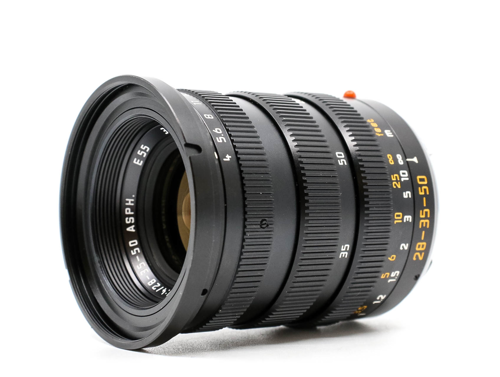
M mount
The Leica Tri-Elmar-M 28-35-50mm f/4 ASPH. Type 1 is a M-mount lens for Leica rangefinder cameras. As of October 2026, it sells from €2,092 used across 6 listings, with a 30-day median of €2,690. Leica price index →
Measured against the 37 other 28mm M-mount lenses in the catalogue.
Few Leica M lenses break the system's one-lens, one-focal-length convention, and the Tri-Elmar-M 28-35-50mm is the more famous of the two that did. Known among collectors as the MATE, for Medium Angle Tri-Elmar, it packs the three most popular reportage focal lengths into a single barrel and was Leica's first multi-focal-length M lens for the public, introduced in 1998 [1][2]. The Type 1 is the original version, identifiable by its 55mm (E55) filter thread, which the two later iterations replaced with a smaller E49 mount. Its appeal is partly practical and partly historical: it offers zoom-like flexibility on a rangefinder, and it occupies a distinctive niche in the M lens family that has kept it sought after on the used market [3].
The design uses eight elements in six groups with an aspherical surface, and the lens is fully rangefinder coupled, focusing to one metre at all three settings. A separate focal-length selector ring sits close to the focusing ring, and on the camera a mechanical linkage raises the matching 28, 35 or 50mm frame lines as the setting is changed, so framing, focusing and metering can be done in one motion on suitable bodies. Because of this frame-line mechanism the MATE works best with 0.72-magnification finders and with later metered and digital M bodies that carry 28mm frame lines; on bodies lacking them, or with 0.85 finders, it makes little sense. The maximum aperture is a modest f/4 across the range, so it is not a low-light lens, and the barrel and hood obstruct the viewfinder noticeably, most at the 28mm setting. Build quality is regarded as exceptional, with the three-ring mechanics often cited as a small engineering showpiece.
Across its short run the MATE appeared in three iterations while the optical formula stayed the same; the changes were cosmetic and mechanical, including barrel coatings, internal blackening to control flare, and reliability of the focal-length switching. The Type 1 carries the E55 thread and uses a hood shared with the 24mm f/2.8 ASPH., whereas the later E49 versions saw a mechanical redesign that many users consider an improvement. None of the early lenses left the factory with six-bit coding, which arrived only later or by retrofit, so an uncoded Type 1 is normal for its date.
Rendering Reviewers describe the MATE as a well-corrected lens that performs strongly at all three settings even wide open, with little to gain from stopping down in central sharpness [4]. The late optical reviewer Erwin Puts tested it against contemporary and older primes and rated it as better than the earlier 28, 35 and 50mm M lenses and broadly competitive with then-current designs. Later commentary notes that more recent Leica primes have moved ahead in resolution and micro-contrast, so by current standards the MATE is very good rather than class-leading.
Distortion and vignetting Without electronic correction the lens shows noticeable vignetting, reported as most pronounced at the 35mm setting, which is why six-bit coding or a manually selected lens profile is commonly recommended on digital M bodies.
Flare resistance Flare control is considered good but not flawless, with the 50mm setting most prone to veiling under difficult light; the deeply recessed front element helps, and the shallow shared hood is a practical limit because it must avoid vignetting at 28mm and blocking the rangefinder windows[5].
Development and Launch Leica released the Tri-Elmar-M 28-35-50mm in 1998 as a single lens covering three classic focal lengths, aimed at photographers who wanted to travel light without changing lenses. It remains one of only two variable-angle-of-view lenses Leica ever sold to the public, alongside the later 16-18-21mm WATE of 2006.
Production Evolution The MATE was produced for roughly nine years, until about 2007, and went through three versions in that time. The optical design was unchanged throughout; the revisions covered the move from the E55 filter thread of the Type 1 to E49 on the later two, along with barrel and internal coating changes intended to improve flare control and the durability of the focal-length switching mechanism. It is widely reported that production ended because the lens was expensive to manufacture rather than because of any optical shortcoming.
Special editions No widely documented factory special editions, military variants or unusual finishes of the Type 1 are recorded in the consulted sources; the lens is distinguished mainly by its three production versions and filter-thread change rather than by limited runs.
Collector Notes The clearest identifier of a Type 1 is its E55 filter thread, as opposed to the E49 of the later versions. Because the correct hood and caps can be hard to find and the original hood is shared with the 24mm f/2.8 ASPH., buyers are advised to seek a lens that still includes its matching hood. Six-bit coding is desirable for digital use and can be added by Leica service if absent, since the lens automatically applies the correct profile per focal length once coded. Note that LeicaLensList records this Type 1 in silver finish; some dealer listings also describe black examples under model number 11890, so finish should be verified against the individual lens.
Good time to buy. The lowest listing is 22% below the 30-day average.
Lowest price Click a mark to open that listing · arrow keys to step, Enter to open
Price against condition for 6 listings of Leica Tri-Elmar-M 28-35-50mm f/4 ASPH. Type 1, €2,092 to €9,259, median €2,571. Mint: 1 at €9,259. Excellent: 4 at €2,092, €2,336, €2,690, €3,113. Good: 1 at €2,453. The full table follows.
| Condition | Lowest | Median |
|---|---|---|
| Mint | €9,259 | €9,259 |
| Excellent | €2,092 | €2,513 |
| Good | €2,453 | €2,453 |
Over the last 18 weeks the median price for the Leica Tri-Elmar-M 28-35-50mm f/4 ASPH. Type 1 has fallen, ranging from €2,690 to €3,263 (now €2,690).
Weekly price (EUR). Median (Good or better) and lowest (Good or better) across 18 weeks. The full figures follow in the table below.
| Week | Median | Lowest |
|---|---|---|
| Jun 1, 2026 | €2,815 | €2,479 |
| Jun 8, 2026 | €2,737 | €2,479 |
| Jun 15, 2026 | €2,941 | €2,479 |
| Jun 22, 2026 | €2,941 | €2,465 |
| Jun 29, 2026 | €2,805 | €2,465 |
| Jul 6, 2026 | €2,490 | €2,465 |
| Jul 13, 2026 | €2,465 | €2,465 |
| Jul 20, 2026 | €2,465 | €2,113 |
| Jul 27, 2026 | €2,805 | €2,465 |
| Aug 3, 2026 | €2,588 | €2,337 |
| Aug 10, 2026 | €2,595 | €2,336 |
| Aug 17, 2026 | €2,608 | €2,338 |
| Aug 24, 2026 | €2,509 | €2,339 |
| Aug 31, 2026 | €2,596 | €2,338 |
| Sep 7, 2026 | €2,594 | €2,338 |
| Sep 14, 2026 | €2,691 | €2,337 |
| Sep 21, 2026 | €2,977 | €2,337 |
| Sep 28, 2026 | €2,453 | €2,092 |
Every shop grades differently. Leica Classic uses letters, Ffordes uses E++ and E+, German dealers write "Zustand B", Japanese dealers write A−. We map all of them onto the one ladder below. Where a shop states its own grade, we print it under ours.
As of October 2026, the Leica Tri-Elmar-M 28-35-50mm f/4 ASPH. Type 1 sells from €2,092 used, with a 30-day median of €2,690, across 6 active listings.
As of October 2026, the Leica Tri-Elmar-M 28-35-50mm f/4 ASPH. Type 1 is sold by 4 sources (6 listings), from €2,092 used: all compared cheapest-first on this page.
Similar lenses you might be interested in
Comments