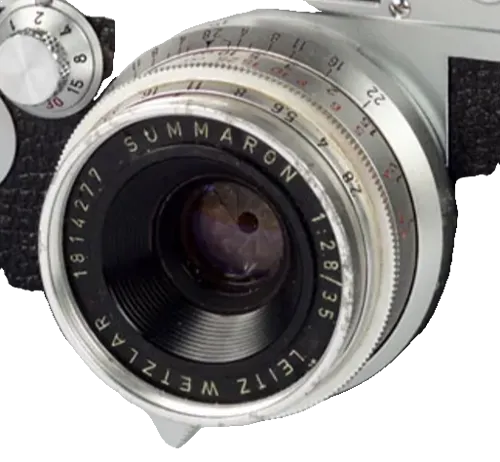
Leica Summicron 35mm f/2 I 8-element LTM, the rare 11008/SAWOO screw-mount version with 10-blade diaphragm and major collector relevance.
Leica Summicron 35mm f/2 I 8-element (LTM)
LTM mount
No listings tracked for this lens right now.
The Leica Summicron 35mm f/2 I 8-element (LTM) is a LTM-mount lens for Leica rangefinder cameras. Leica price index →
How it compares
Measured against the 33 other 35mm LTM-mount lenses in the catalogue.
Specification
About this lens
Leica Summicron 35mm f/2 I 8-element (LTM)
The Leica Summicron 35mm f/2 I 8-element in Leica Thread Mount is the rare screw-mount version of Leica's first 35mm Summicron. Introduced in 1958 under the Leitz code SAWOO and later catalogue number 11008, it appeared near the end of Leica's screw-mount era, when the M3 and newly introduced M2 were rapidly establishing the bayonet system as Leica's principal rangefinder platform. The limited remaining demand for new high-speed LTM lenses resulted in substantially fewer screw-mount examples than bayonet versions.
The SAWOO uses the same fundamental eight-element, six-group optical formula associated with the first-generation 35mm Summicron. It has an E39 filter thread, full rangefinder coupling and focuses to 1 metre. Unlike the bayonet versions, the LTM lens uses a 10-blade diaphragm rather than the 16-blade mechanism found in the 11108 and 11308. The standard production lens has a silver chrome finish and weighs approximately 150 g.
The LTM version should not be grouped mechanically with the 11308 non-goggled M lens or the 11108 M3 goggled version. Although all three belong to the same optical generation, their catalogue identities, focusing limits and diaphragm mechanisms differ. Factory bayonet lenses assembled around screw-mount-derived chassis can further complicate identification, making inspection of the actual mount and factory construction important.
Optical qualities
Rendering
The eight-element Summicron employs a largely symmetrical optical construction that was highly ambitious for a compact 35mm f/2 rangefinder lens in the late 1950s. At maximum aperture, published optical analysis describes comparatively low overall contrast with stronger fine-detail definition around the centre than toward the outer image field. Stopping down noticeably increases contrast and improves definition across the frame.
Sharpness
Fine detail is visible around the optical axis at f/2, while edges and corners are softer. At f/2.8 centre performance improves significantly, and further stopping down increases uniformity. By the middle apertures the lens records fine detail with substantially greater clarity across most of the image.
Flare resistance
Flare is a documented characteristic of the first design at wider apertures, associated partly with residual coma. Modern performance can vary considerably according to condition because haze, coating wear, separation and cleaning damage are common concerns in lenses of this age.
Distortion and vignetting
The symmetrical design provides extremely low distortion, with specialist optical literature describing distortion as negligible. Vignetting is comparatively high at full aperture, approximately 2.5 to 2.6 stops in published testing of the optical design, and decreases when stopped down.
History
Development and Launch
The first 35mm f/2 Summicron was introduced at Photokina in 1958. Walter Mandler and the Leitz optical department in Midland, Canada developed the eight-element, six-group design during a period of rapid development in high-refractive-index optical glasses.
Leitz offered the lens in several configurations. SAWOO/11008 was the Leica Thread Mount version, while separate bayonet versions were produced for the M2-type finder system and for the M3 with an optical viewing attachment.
The LTM lens was particularly unusual because its launch occurred several years after Leica had introduced the M3. It therefore served a shrinking but still important population of Leica screw-mount users who wanted Leica's newest high-speed 35mm design without changing camera systems.
Production Evolution
The SAWOO remained in the Leica catalogue from approximately 1958 to 1963. Production took place in both Wetzlar and Midland, with surviving German and Canadian examples documented.
Published production totals are not entirely uniform. Leica Wiki records 577 screw-mount examples, while several collector references round the figure to approximately 500. The discrepancy is small but significant enough that a precise production total should not be treated as completely settled.
The standard LTM version retained the eight-element, six-group optical design and 10-blade diaphragm. Later bayonet Summicron generations changed substantially, first moving to six-element formulas and later to other optical constructions.
Special Editions/Variants
Extremely rare factory black-finish SAWOO lenses are documented. Leitz Photographica Auction has sold multiple original black screw-mount examples and describes them as lenses most probably produced by Leitz to special order. Known examples span several years and include both chrome and black details in their mechanical construction.
No separate normal catalogue number for the black special-order LTM lenses is confirmed. They therefore belong historically to the SAWOO family rather than representing a separate standard catalogue model.
A special chrome prototype made from aluminium is also documented in collector literature. This should be regarded as a prototype or experimental factory piece rather than a normal production variant.
Collector Notes
The primary identification point is the original Leica Thread Mount combined with SAWOO/11008 identity and a 1 metre focusing scale. Genuine factory LTM examples are scarce enough that mount originality should be checked carefully.
Collectors should distinguish original SAWOO lenses from M-mount lenses built around a screw-mount-derived chassis. Leitz sometimes fitted a screw-to-bayonet adapter at the factory and secured it with a small screw. Such a bayonet lens is a legitimate factory M version, not an LTM lens simply because an LTM-style chassis is visible beneath the adapter.
Rare black examples require especially careful inspection. Leitz Auction documents genuine factory special-order black lenses, so black finish alone does not indicate repainting. However, the value of original black examples makes later repainting a significant concern. Serial number, engraving style, infinity-lock finish and wear patterns should be examined together.
The glass should be inspected for haze, separation, coating damage and cleaning marks. The rangefinder cam, 1 metre close-focus calibration and 10-blade diaphragm should function correctly. Period accessories include E39 filters, the SBLOO 35mm external finder for screw-mount cameras and Leica hoods including IROOA/12571 and 12585.
Sources
- Leica Wiki. Summicron (I) f= 3.5 cm 1:2wiki.l-camera-forum.com →
- Summichronica. Leica Screw Mount Lenses, 35mmsummichronica.com →
- Leitz Photographica Auction. Summicron 2/35mm SAWOOleitz-auction.com →
- Leitz Photographica Auction. Summicron 2/35mm M39 SAWOO blackleitz-auction.com →
- Leica Society International. A New Old 8-Element 35/2 Summicron from Chinalhsa.squarespace.com →
- CollectiBlend / Erwin Puts. Leica Lens Compendium, 2.0/35 Summicron (1)collectiblend.com →
Special editions
Factory black SAWOO: Extremely rare black-finish LTM examples were produced by Leitz to special order. No separate catalogue number is confirmed.
Aluminium prototype: A special chrome-finish aluminium prototype is documented. It was not a regular production model and has no confirmed separate commercial catalogue number.
Where to buy
Related lenses
Similar lenses you might be interested in
Comments