Best price Excellent
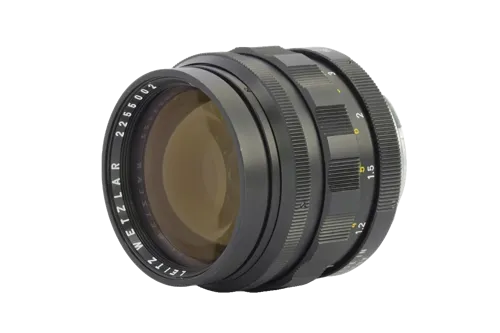
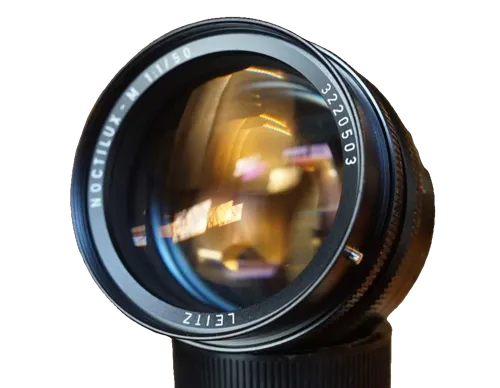
Leica Noctilux 1,2/50mm 11820
Sold by classic.leica-camera.com
€31,181 ≈ $33,675
The Leica Noctilux 50mm f/1.2 is a rare 1960s M-mount lens, the first in series with two aspherical elements, prized by collectors.
M mount
The Leica Noctilux 50mm f/1.2 is a M-mount lens for Leica rangefinder cameras. As of October 2026, it sells from €31,181 used across 2 listings, with a 30-day median of €22,727. Leica price index →
Measured against the 76 other 50mm M-mount lenses in the catalogue.
The Noctilux 50mm f/1.2 holds a singular place in Leica history as the first lens produced in series to use aspherical elements, a distinction that turned a niche low-light optic into one of the most coveted collector items in the M system. Released in 1966 under model number 11820, it was Leica's answer to growing demand for fast lenses among photojournalists, and at f/1.2 it was the fastest Leica lens of its day [1][2]. The design originated in research that began at Leica in the late 1950s, when work on aspherical surfaces produced experimental optics such as a 1958 Summaron 35mm prototype and a 52mm f/1 aspherical prototype in 1959; Leica judged the image quality at f/1 inadequate and settled on f/1.2 for the production lens. The first prototypes followed in April 1964, with the optical design credited to Helmut Marx and Paul Sindel, Marx being the successor to Max Berek as head of photographic lens design in Wetzlar and the designer of the first 50mm Summicron in 1953.
The lens uses a compact six-element configuration in four groups with a maximum aperture of f/1.2, and its two aspherical elements, one at the front and one at the rear, were intended to control spherical aberration at full aperture. Build quality reflects the difficulty of its manufacture: the aspherical elements were ground on a single, specially built machine that had to be operated manually, and Leica relied on essentially one operator, Gerd Bergmann, who discarded many elements that failed to meet tolerance. The lens couples to the rangefinder and mounts on the Leica M bayonet. A notable handling detail is that the original lens had no filter thread on the front element; filters attached instead to the clip-on lens hood, a point that distinguishes the vintage optic from the 2021 reissue, which added a front filter thread.
Production ran only from 1966 to 1975, after which Walter Mandler's f/1 Noctilux of 1976, built without aspherical elements, took over the Noctilux name. Reported output of the f/1.2 has long varied, with estimates ranging widely, but Leica and other sources cite a total of 1,757 units. The lens was among the first serially produced Leica optics offered in a black finish, and during the period when Leica was moving from silver chrome to black paint a very small number of silver-finish examples are reported to exist. Its rarity and historical importance have made it a high-value collectible, with complete lenses trading well above 20,000 dollars and even original hoods commanding several thousand dollars.
Rendering The Noctilux 50mm f/1.2 is valued more for its drawing character at wide aperture than for clinical performance. At f/1.2 it produces very shallow depth of field with soft transitions and a distinctive bokeh, qualities that give it a vintage, dreamlike look favored for portraits and atmospheric work. The aspherical elements were specifically intended to reduce spherical aberration at full aperture and improve the image field compared with a conventional spherical design of the same speed. By later standards the lens does not compete with modern fast Leica optics on measured performance, and commentary on the reissue notes that its character, rather than outright sharpness or contrast, is its defining trait.
Development and Launch The lens grew out of Leica's late 1950s program to manufacture aspherical surfaces, which yielded several prototypes before a workable fast standard lens emerged. After a 52mm f/1 aspherical prototype proved unsatisfactory, the design was fixed at f/1.2, with first prototypes in April 1964 and a production release in 1966 as the 11820. It arrived during a period of competition among Japanese and German makers for fast standard lenses, and Leica's use of two aspherical elements set it apart from the f/1.2 designs of Canon, Nikon and Minolta in the same era.
Production Evolution The f/1.2 remained in production only until 1975. A planned f/1 successor with three aspherical elements was researched after 1966 but abandoned around 1970 because aspherical manufacturing was still immature and production costs were high; the f/1 Noctilux that eventually replaced it in 1976 used a fully spherical design.
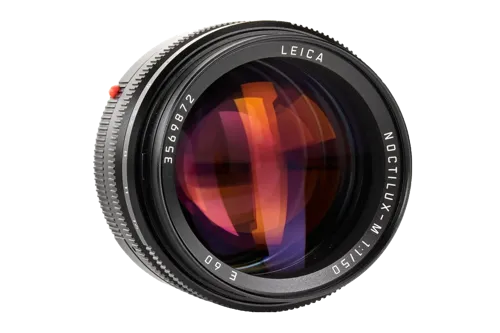
Special editions No widely documented factory special editions of the original f/1.2 exist. Sources do report a very small number of silver-finish examples produced during the transition from silver chrome to black paint lenses, alongside the standard black version. In 2021 Leica reissued the design as the Noctilux-M 50 f/1.2 ASPH. under a different model number, a separate modern product rather than a variant of the vintage lens.
Collector Notes Original f/1.2 lenses are scarce and expensive, and prices have made even genuine hoods valuable, so accessories are worth verifying. The absence of a front filter thread on the original is a quick identification check, since the reissue carries one. Reported production figures vary considerably in older literature, though Leica and recent sources converge on 1,757 units. Buyers should confirm the integrity of the hand-ground aspherical elements and overall optical condition given the lens's age and manufacturing complexity.
Prices are running high. The lowest listing is 37% above the 30-day average.
Lowest price Click a mark to open that listing · arrow keys to step, Enter to open
Price against condition for 2 listings of Leica Noctilux 50mm f/1.2, €31,181 to €31,181, median €31,181. Excellent: 1 at €31,181. Good: 1 at €31,181. The full table follows.
| Condition | Lowest | Median |
|---|---|---|
| Excellent | €31,181 | €31,181 |
| Good | €31,181 | €31,181 |
Over the last 18 weeks the median price for the Leica Noctilux 50mm f/1.2 has fallen, ranging from €22,727 to €34,123 (now €22,727).
Weekly price (EUR). Median (Good or better) and lowest (Good or better) across 18 weeks. The full figures follow in the table below.
| Week | Median | Lowest |
|---|---|---|
| Jun 1, 2026 | €30,000 | €23,000 |
| Jun 8, 2026 | €30,000 | €23,000 |
| Jun 15, 2026 | €30,000 | €23,000 |
| Jun 22, 2026 | €30,000 | €23,000 |
| Jun 29, 2026 | €30,000 | €23,000 |
| Jul 6, 2026 | €31,750 | €23,178 |
| Jul 13, 2026 | €31,681 | €23,127 |
| Jul 20, 2026 | €31,603 | €23,070 |
| Jul 27, 2026 | €31,903 | €23,289 |
| Aug 3, 2026 | €30,027 | €23,057 |
| Aug 10, 2026 | €30,021 | €23,170 |
| Aug 17, 2026 | €30,414 | €23,389 |
| Aug 24, 2026 | €32,341 | €32,341 |
| Aug 31, 2026 | €32,283 | €32,283 |
| Sep 7, 2026 | €32,200 | €32,200 |
| Sep 14, 2026 | €31,833 | €31,833 |
| Sep 21, 2026 | €31,675 | €22,727 |
| Sep 28, 2026 | €31,181 | €31,181 |
Every shop grades differently. Leica Classic uses letters, Ffordes uses E++ and E+, German dealers write "Zustand B", Japanese dealers write A−. We map all of them onto the one ladder below. Where a shop states its own grade, we print it under ours.
As of October 2026, the Leica Noctilux 50mm f/1.2 sells from €31,181 used, with a 30-day median of €22,727, across 2 active listings.
As of October 2026, the Leica Noctilux 50mm f/1.2 is sold by 1 source (2 listings), from €31,181 used: all compared cheapest-first on this page.
Similar lenses you might be interested in
Comments