
Leica Elmar 5cm f/3.5 LTM
The Leica Elmar 5cm f/3.5 LTM is a LTM / M39-mount lens for Leica rangefinder cameras. Leica price index ↗
Reference maintained by Thomas Boots

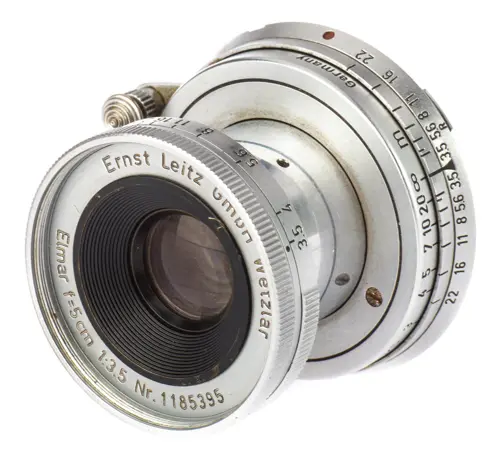
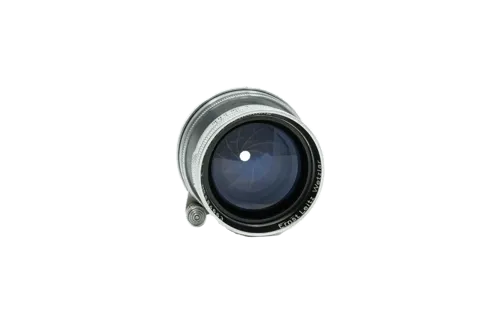
Leica Elmar 5cm f/3.5 LTM (Chrome)
The Leica Elmar 5cm f/3.5 LTM in chrome is a collapsible standard lens produced for Leica screw-mount rangefinder cameras. Introduced in 1933, it followed the earlier nickel-finished Elmar and became one of the defining standard lenses of the Barnack Leica system. Its compact construction, long production history, and close association with cameras such as the Leica II, III, IIIa, IIIb, and IIIc make it an important collector lens [1].
The lens uses the classic four-element, three-group Elmar optical construction developed by Max Berek. Although frequently described as Tessar-like, the Elmar places its aperture stop between the first and second elements, rather than in the usual Tessar position. The lens is housed in a chrome-plated brass collapsible barrel with a focusing lever, infinity lock, front-mounted aperture control, and automatic rangefinder coupling on standardized Leica screw-mount cameras [1][2].
Focusing extends to 1 metre. The barrel must be fully extended and rotated into its locked position before photography. The front accepts A36 clamp-on filters and accessories rather than a conventional 36 mm threaded filter. The FISON hood was the standard Leitz hood associated with the 5cm Elmar [3][4].
The chrome Elmar was produced in both uncoated and coated forms. Factory coating is documented from serial number 598201, with production beginning in 1946. Earlier chrome lenses are normally uncoated, although some were subsequently returned to Leitz for polishing and coating. Later examples also adopted the international aperture sequence in place of the earlier Continental scale [1].
This entry covers the regular chrome, black-scale Leica Thread Mount version produced before the redesigned Red Scale Elmar. It does not include the earlier nickel Elmar, the improved Red Scale version introduced in 1951, or the later native Leica M-mount Elmar.
Optical qualities
Rendering
The four-element Elmar design was developed to provide strong central definition with a very small number of glass surfaces. Its forward aperture-stop position restricts some peripheral rays, supporting central definition but contributing to vignetting, astigmatism, and coma toward the outer image field [2].
Uncoated examples generally produce lower contrast in backlit or high-flare conditions than later coated lenses. Factory coating improved light transmission and resistance to veiling flare, although the underlying optical construction remained substantially unchanged until the Red Scale redesign [1][2].
Sharpness
Contemporary Leitz literature described the Elmar as capable of good definition at full aperture across the 35mm negative. Collector and technical sources generally describe the centre as strongest at f/3.5, with the outer field improving as the lens is stopped down. Performance is typically most even around f/8 [1][2][4].
Contrast and color
Pre-1946 uncoated lenses have fewer air-to-glass surfaces than many faster contemporary lenses, but remain more sensitive to stray light than coated examples. Later factory-coated lenses normally show improved contrast under difficult lighting. Color and contrast also depend strongly on coating condition, internal haze, cleaning marks, and previous servicing.
Flare resistance
Use of the FISON hood is advisable, particularly with uncoated examples. Internal haze, polished coatings, scratched front elements, and oil contamination can have a greater effect on contrast than the nominal production version alone.
History
Development and Launch
Max Berek developed the Elmar after recomputing the earlier five-element Elmax design. New optical glass allowed the rear cemented group to be simplified, producing a four-element lens with two cemented rear elements. The Elmar name was adopted in 1926, and interchangeable standardized screw-mount versions followed with the development of the Leica I Model C and Leica II [1].
Chrome-finished interchangeable Elmars were introduced in 1933. The chrome barrel corresponded with Leitz's wider transition from nickel to chrome finishes during the early 1930s. After 1936, regular production of this version was predominantly chrome [1].
The lens became one of the most widely produced Leica optics. Its modest maximum aperture was balanced by compact dimensions, low weight, and the ability to collapse almost completely into the camera body.
Production Evolution
Early chrome lenses were uncoated and retained the older Continental aperture sequence. Infrared focusing marks appeared on some later prewar examples. Factory coating began on 2 April 1946, associated with serial number 598201 [1].
During late 1946 or early 1947, the aperture scale changed from the Continental progression, including f/4.5, f/6.3, and f/9, to an international sequence incorporating f/5.6, f/8, and related values. Some later examples stop down to f/22, while earlier lenses normally terminate at f/16 or use an older scale ending at f/18 [1][3].
Leitz offered services that could alter an individual lens from its original configuration. These included rangefinder coupling, mount standardization, metric or imperial scale conversion, repolishing, and anti-reflection coating. Consequently, coating and engraving details do not always correspond perfectly with a lens's original production date [1].
The improved Red Scale Elmar appeared in 1951. It used revised optics and lanthanum glass, reversed the position of the focusing and depth-of-field scales, and added red-filled scale markings. It should be treated as a separate collector and database version [1].
Special Editions/Variants
The normal chrome lens was supplied with metric or foot distance scales, with or without infrared markings, and with several aperture-scale configurations. These are production variations within the chrome LTM model rather than commercial special editions.
Factory and institutional engravings are documented, including examples marked Leitz Eigentum, Luftwaffen Eigentum, Heer, and W. haven. A black-finished version was also produced to accompany a limited group of black Leica IIIf cameras. No separate numeric retail model number has been confirmed for these variants [1].
Collector Notes
Collectors should distinguish the regular chrome version from the earlier nickel Elmar and the later Red Scale lens. The ordinary chrome version has black-filled distance and depth-of-field markings and lacks the reversed red scale arrangement of the redesigned lens.
Serial numbers, aperture sequences, coating, infrared marks, infinity-lock shape, and engraving style should be considered together. Coating alone is not sufficient for dating, because Leitz offered factory coating and repolishing of older lenses.
Some Elmars originally fixed to Leica I Model A cameras were later converted into interchangeable lenses. The inscription F=50mm is frequently associated with converted fixed-mount lenses, while f=5cm is more typical of lenses manufactured as interchangeable examples. This identification method should be supported by inspection of the mount, rangefinder cam, serial number, and factory-standardization marks [1].
Before purchase, inspect the front element for cleaning marks, coating damage, haze, fungus, and polishing. The collapsible tube should extend smoothly and lock securely. The focusing helicoid, infinity lock, aperture tab, and rangefinder coupling should also be checked.
When adapting the lens to a Leica M camera, a suitable 50mm LTM-to-M adapter is required. The lens should not be collapsed into a modern digital body unless rear-element and internal-body clearance have been independently verified.
Special editions
- Black-finished Leica IIIf matching variant: Factory black finish with white engravings. Separate numeric model number not confirmed.
- Military and institutional engravings: Luftwaffen Eigentum, Heer, W. haven, and Leitz Eigentum examples are documented. Separate model numbers not confirmed.
- Metric and foot scales: Normal regional production variants, not Special Edition-tagged database entries.
- Factory-coated chrome version: Regular production evolution from 1946, not a Special Edition.
- Red Scale Elmar: A separate later optical and collector version, not part of this entry.
Sources
- [1] Summichronica. Leica Screw Mount Lenses, 50mm. https://www.summichronica.com/screw-mount-lenses-50mm
- [2] Erwin Puts, CollectiBlend Library. Leica Lens Compendium, Chapter 2. https://collectiblend.com/Library/Leica_Lens_Compendium_Chapter2.php
- [3] Leica Wiki. Elmar (I) f=5 cm 1:3.5. https://wiki.l-camera-forum.com/leica-wiki.en/index.php/Elmar_%28I%29_f%3D_5_cm_1%3A3.5
- [4] Ernst Leitz, Wetzlar. Leica Interchangeable Lenses, Catalogue No. 1356. https://www.pacificrimcamera.com/rl/01326/01326.pdf
Related Lenses
Similar lenses you might be interested in
Comments