A late-1940s British 85mm f/2 portrait lens with six elements in four groups, coupled Leica M39 focusing, E49 filters and 1.22m close focus.
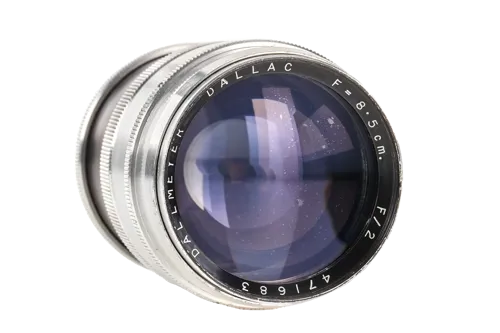
Dallmeyer Dallac 85mm f/2
LTM mount
No listings tracked for this lens right now.
The Dallmeyer Dallac 85mm f/2 is a LTM-mount lens for Leica rangefinder cameras. Leica price index →
How it compares
Measured against the 14 other 85mm LTM-mount lenses in the catalogue.
Specification
About this lens
Dallmeyer Dallac 85mm f/2
The Dallmeyer Dallac 85mm f/2 is a British short telephoto made in the late 1940s for Leica screw-mount rangefinder cameras. It combines an 85mm focal length and f/2 maximum aperture with an original rangefinder-coupled M39 focusing mount. The recorded optical construction is six elements in four groups, and surviving documentation describes a double-Gauss type arrangement. The minimum focusing distance is approximately 1.22 metres, and the front accepts E49 filters.
Optical qualities
Rendering
The six-element, four-group formula is consistent with a fast normal-to-short-telephoto design of the period. At 85mm on 35mm film, the lens narrows the angle of view and allows a comfortable camera-to-subject distance for portraits, details and selective landscape work. The f/2 aperture provides meaningful control over depth of field, especially near the lens's minimum focus.
At wider apertures
At f/2, the central plane of focus can be isolated against a less defined background. The transition depends on subject distance and the texture of the scene; no single adjective can describe all backgrounds. Focus placement is critical, and even a correctly coupled rangefinder system may need calibration after decades of service. A practical test should compare the indicated distance with the image plane rather than relying solely on smooth mechanical movement.
Stopped down
Closing the aperture by one or two stops increases depth of field and generally produces a more even, higher-contrast image. This is the more suitable working range when the subject extends beyond the central portrait zone. At smaller apertures, diffraction eventually limits the finest detail, while mechanical blade shape can become more visible in out-of-focus highlights. The available records do not give a verified diaphragm blade count for every production version, so this entry leaves it unspecified.
Handling and compatibility
The 1.22m minimum focus provides normal portrait working distances but not close-up reproduction. E49 filters are readily described by thread size, although an original hood must also clear the rangefinder view and match the front construction. The original coupled M39 mount should focus to infinity on a correctly registered Leica-thread body.
History
Development and Launch
J. H. Dallmeyer was a London optical and photographic equipment maker with roots in the nineteenth century. The Science Museum Group identifies the firm as British and London based, while its biographical record traces John Henry Dallmeyer's work in optical instrument making. By the time the Dallac appeared, the name represented an established British lens manufacturer rather than a new post-war brand.
Leitz Auction dates its coupled 8.5cm f/2 example to the 1940s, and the Flashback Camera record places the model in the late 1940s. The specification fitted the period market for fast short telephotos usable for portraiture and lower-light photography on compact 35mm rangefinders. No exact launch month, original list price or named optical designer has been confirmed in the consulted sources.
Production Evolution
Surviving examples are documented in both black-and-chrome and other metal-finish presentations. Flashback Camera reports an aluminium barrel associated with Cooke & Perkins and notes that several variations are known. That record is valuable, but a complete factory chronology has not been located. Finish and engraving differences should therefore be documented as observed variants rather than arranged into an unsupported sequence.
The available model record supports a six-element, four-group, double-Gauss type construction. It does not establish that every mechanical variant received a different optical formula. Likewise, no reliable production total is available here. Auction descriptions often use scarcity language, but those terms are market observations rather than factory data.
Special Editions/Variants
The clearest variants concern the barrel finish and external presentation. A black-and-chrome coupled M39 lens is documented by Leitz Auction, while the retailer record discusses an aluminium barrel and period promotion under the Dalcote coating name. These details may help place an example, but they do not alone prove a special edition or optical revision.
Collector Notes
Collectors should verify the Dallmeyer and Dallac engravings, the 8.5cm or 85mm f/2 specification, the Leica thread, and the presence of a functional coupling cam. Barrel finish, focusing scale, filter fit and manufacturer markings on the mechanical assembly can help distinguish original configurations from later conversions. A smooth focus ring does not by itself prove correct optical register.
Inspection should include the coating, internal haze, separation, diaphragm operation and signs of previous disassembly. Fast lenses are sensitive to spacing and centring errors, so a photographic test at f/2 is useful even when the glass appears clean. The E49 front and 1.22m minimum focus are practical reference points for checking completeness and scale travel. Cases, caps and hoods add historical interest only when their fit and provenance are credible.
Sources
- Leitz Auction: Dallmeyer Dallac 2/8.5cm in coupled Leica M39leitz-auction.com →
- Flashback Camera: Dallmeyer Dallac 85mm f/2flashbackcamera.jp →
- Science Museum Group: J. H. Dallmeyer Ltdcollection.sciencemuseumgroup.org.uk →
- Science Museum Group: John Henry Dallmeyercollection.sciencemuseumgroup.org.uk →
Where to buy
Related lenses
Similar lenses you might be interested in
Comments