The Carl Zeiss Hologon 15mm f/8 11003 is a rare fixed-aperture Leica M ultra-wide lens supplied with a dedicated finder and center filter.
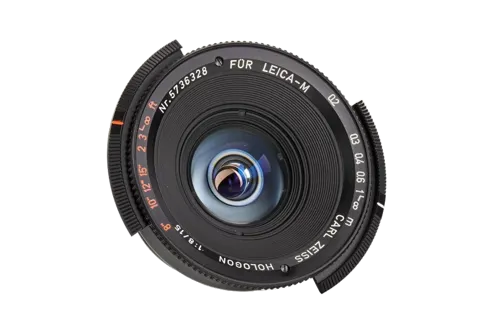
Carl Zeiss Hologon 15mm f/8
M mount
No listings tracked for this lens right now.
The Carl Zeiss Hologon 15mm f/8 is a M-mount lens for Leica rangefinder cameras. Leica price index →
How it compares
Measured against the 5 other 15mm M-mount lenses in the catalogue.
Specification
About this lens
Carl Zeiss Hologon 15mm f/8 for Leica M 11003
The Carl Zeiss Hologon 15mm f/8 for Leica M, Leica order number 11003, is one of the rarest ultra-wide lenses made for the Leica M system. It was manufactured by Carl Zeiss in Oberkochen and sold for Leica M cameras as the “Carl Zeiss Hologon for Leica M.” Leica Wiki lists the lens with Leica M-bayonet mount, 3 elements in 3 groups, fixed f/8 diaphragm, 110 degree diagonal angle of view, 0.2m close focusing distance, anodized aluminum construction and 110g weight .
The lens is a very compact fixed-aperture ultra-wide built around the Hologon concept developed by Erhard Glatzel and his Zeiss design team. It does not use a normal adjustable iris. Instead, the lens is effectively fixed at f/8, with the dedicated graduated neutral density center filter, Leica accessory 13002, used to reduce edge fall-off and produce an exposure effect equivalent to f/16. The complete outfit normally includes the lens, special 15mm finder with spirit level, center filter, caps and fitted box .
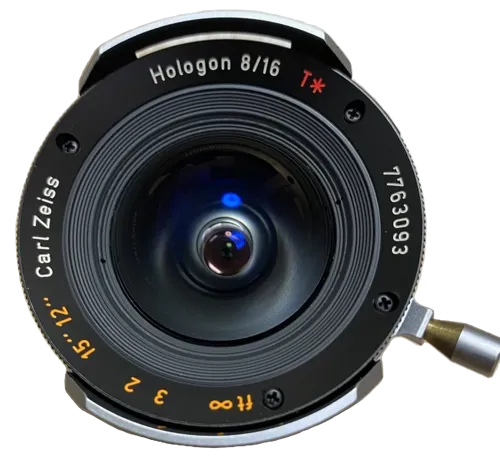
This lens must be kept separate from the later Carl Zeiss Hologon T* 16mm f/8 for Contax G. The Leica M 15mm Hologon uses a 3 element, 3 group design and was made in very small numbers in the 1970s. The Contax G Hologon is a later 16.5mm, 5 element, 3 group T* lens from the 1990s and belongs as a separate lens only when converted to Leica M. The native Leica M Hologon 15mm f/8 is a separate collector-grade entry .
Optical qualities
Rendering
The Hologon 15mm f/8 is best known for extremely wide rectilinear coverage and very low geometric distortion. Leitz Auction describes the lens as having a 110 degree angle of coverage with almost no distortion, while noting visible vignetting that was compensated by the special center filter.
Sharpness
Reliable modern bench testing is limited. The lens was built as a highly corrected ultra-wide lens for film use, but its fixed f/8 aperture, extreme field angle and strong natural light fall-off mean it should not be described like a modern digital ultra-wide. Performance should be evaluated on film or on a compatible digital body with careful attention to edge behavior and sensor color response .
Vignetting and center filter
Strong natural vignetting is a core part of the design. Leica Wiki lists the graduated density filter 13002 with a 4x exposure factor, and Leitz Auction notes that the special center filter was supplied to compensate for the lens’s slight vignette. Complete sets with the original filter are substantially more desirable to collectors.
Digital use
Digital compatibility is restricted. Leica Wiki states that the lens cannot be used on the Leica M8 or M9, and later Leica manuals also list the Hologon 15mm f/8 among lenses that cannot be used on certain digital M bodies. Modern use should therefore be checked body by body before mounting, especially because of the deep rear projection and extreme ray angles .
Handling
The lens is scale-focused rather than rangefinder-coupled. Its 15mm focal length and fixed f/8 aperture provide very broad depth of field, but accurate close focusing at 0.2m still requires careful distance estimation. The dedicated external finder is essential for framing because Leica M bodies do not provide 15mm framelines.
History
Development and Launch
The Hologon design originated at Carl Zeiss in the 1960s and was first associated with the Zeiss Ikon Hologon Ultrawide camera. After Zeiss had introduced the fixed-lens Hologon camera, Zeiss later manufactured the 15mm f/8 Hologon for Leitz in Leica M mount. Leitz Auction states that from 1972 Zeiss manufactured the lens for Leitz, and that it appeared in the Leitz catalogue as “Carl Zeiss Hologon for Leica M” until 1975.
Production Evolution
The main production period is generally given as 1972 to 1976. Leica Wiki lists the production era as 1972 to 1976 with approximately 500 lenses, while Christie’s states that three batches were produced between 1972 and 1976 with a total production of 350. Other collector sources repeat smaller figures such as 225. Because these numbers conflict, a single absolute production count should be avoided and the lens should be described as very small production, with published estimates varying by source .
Special Editions/Variants
No commemorative factory special edition is widely documented. The collector-relevant form is the original Leica M outfit under order number 11003, normally supplied with the special 15mm finder, graduated center filter, caps and maker’s box. Known auction and Leica Classic examples show late serial-number lenses from 1975 with complete accessory sets.
Collector Notes
Collectors should verify the front engraving, Leica M mount, serial number, original 15mm finder, center filter 13002, caps, box and documentation. The center filter and finder are especially important because they are part of the intended outfit and strongly affect completeness. Buyers should also check rear element condition, haze, cleaning marks, coating damage, filter glass condition and whether the lens has been separated from a complete set. The lens should not be confused with Contarex Hologon camera lenses, modified conversions, later Contax G Hologon 16mm lenses or modern replica lenses.
Sources
- Leica Wiki. *15mm f/8 Hologon*wiki.l-camera-forum.com →
- Leitz Auction. *Carl Zeiss Hologon 8/15mm 11003*leitz-auction.com →
- Leica Classic. *Carl Zeiss f. Leica M Hologon 8/15mm 11003*classic.leica-camera.com →
- Christie’s. *Hologon f/8 15mm. no. 5735930*christies.com →
- Phillip Reeve. *Review: Contax-G 16mm 8.0 Hologon*phillipreeve.net →
- Street Silhouettes. *Zeiss 15mm f/8 Hologon-M for Leica + Leica M10*streetsilhouettes.com →
- Leica Camera. *Leica M Monochrom Typ 246 Instructions*lensrentals.com →
Where to buy
Related lenses
Similar lenses you might be interested in
Comments