Best price Fair
YASHICA (ヤシカ) YASHIKOR 5cm/2.8 (L39)
Sold by Nisshin Camera
€142 ≈ $153
The Yashica Yashikor 50mm f/2.8 (first type) is a Tessar-type LTM rangefinder lens supplied with the Yashica YE, a scarce late Japanese Leica copy.
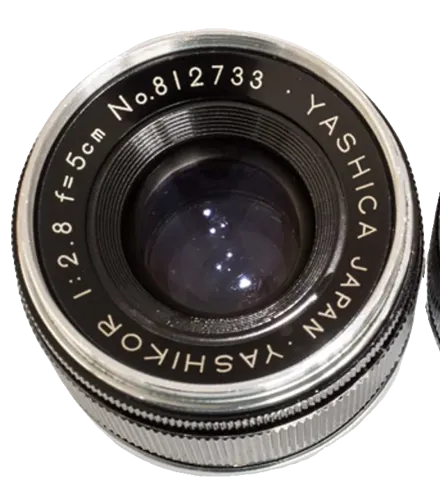
LTM mount
The Yashica Yashikor 50mm f/2.8 I (81-series) is a LTM-mount lens for Leica rangefinder cameras. As of October 2026, it sells from €142 used across 1 listing, with a 30-day median of €142. Leica price index →
Measured against the 108 other 50mm LTM-mount lenses in the catalogue.
This is the four-element normal lens that Yashica fitted as standard to the Yashica YE rangefinder, a screw-mount camera that emerged from Yashica's takeover of the Nicca Camera Company at the close of the 1950s [1][2]. The "I" designation distinguishes the earlier of two outwardly similar but optically distinct Yashikor 50mm f/2.8 lenses: this first type uses a Tessar-style four-element, three-group formula with nine curved aperture blades, while the later second type adopted a five-element design with six straight blades. Collector interest in the lens is bound up with the camera it came on, since the YE was apparently sold only in Japan and is a comparatively obscure entry among Leica thread-mount copies.
The lens is a compact, rangefinder-coupled unit in Leica thread mount that follows the standard Japanese 5cm normal-lens conventions of its era, with a fixed (non-collapsible) barrel and a click-stopped aperture running to f/22. Its four-element, three-group construction and nine-bladed iris place it in the long line of Tessar-derived budget normals, and the two-tone chrome and black finish matches the trim of the YE body. As a coupled LTM lens it works on the YE and on other Leica screw-mount bodies, with rangefinder focusing down to roughly a metre.
Identification rests largely on the serial number and physical details documented by collectors. The first-type lenses carry serial numbers beginning with the "81" prefix, have nine curved blades, a magenta-tone coating, a dished front retaining ring, and progressively wider spacing on the aperture scale; the depth-of-field ring at the rear is not knurled. The later "91" prefix lenses differ in almost every internal respect: five elements in four groups, six straight blades, an amber coating, evenly spaced aperture markings, and a knurled rear ring. Early first-type examples can be found marked in either feet or metres, with metric scales more common on later "81" units. Because the two versions share a near-identical outward look, buyers relying on appearance alone can easily confuse them, so the serial prefix and blade count are the reliable checks.
Rendering Independent test data on this lens is scarce, and most assessments come from collector observation rather than formal review. As a coated Tessar-type four-element design of the late 1950s, it belongs to a class generally regarded as capable but modest, and one researcher who compared the two Yashikor versions concluded that he would not expect major differences in performance between them, noting that the five-element later type might hold a slight edge at the borders while the nine curved blades of this Tessar type could give more pleasing out-of-focus rendering. The same source stresses that with lenses of this age, physical condition matters far more than the formula. Given the limited documentation, firm claims about sharpness, contrast, flare, or distortion are not well supported.
Development and Launch The Yashikor 50mm f/2.8 reached the market with the Yashica YE, the first camera Yashica produced after acquiring Nicca, a respected maker of quality Leica screw-mount cameras. The YE was essentially a refinement of Nicca's lever-wind 3-F and Type 33 bodies, which themselves descended from the Leica IIIc and IIIf, and it was offered as a package with the f/2.8 Yashikor much as the contemporaneous YF was paired with an f/1.8 Yashinon. Yashica, long successful in selling twin-lens reflex cameras as fixed packages, applied the same commodity approach here, marketing the YE essentially as a body-and-lens unit rather than offering a range of interchangeable standard optics. The cameras arrived in 1959, just as rangefinders were ceding the market to single-lens reflexes, and the line was short-lived.
Production Evolution During the run of the f/2.8 Yashikor, Yashica introduced a second, optically different lens under the same name and specification. Drawing on research by Japanese collector Mikio Awano, the change is tracked through the serial-number prefixes, with the earlier Tessar-type "81" lenses giving way to the five-element "91" lenses; according to that work, the later type appears on the great majority of surviving YE cameras, suggesting the changeover came relatively early in production. The motivation for the switch is debated, with sourcing considerations thought more likely than a deliberate performance upgrade.
Special editions No major factory special editions of this lens are widely documented. A separate and rarely seen 5cm f/2 Yashikor existed in the same family and is associated mainly with the YF, but it is a different lens from the f/2.8 covered here.
Collector Notes The most important check before buying is the serial-number prefix, since "81" and "91" lenses look alike but are entirely different optically and mechanically. Buyers should also confirm whether a given lens is marked in feet or metres and inspect for the haze and coating deterioration common to optics now well over sixty years old. Because the YE was a Japan-only model and the lenses were tied to it, the f/2.8 Yashikor is encountered less often than mainstream LTM normals, and an example found on a YF body may be a later substitution rather than an original fitment, a point of uncertainty noted in the collector record. Some published specification tables for the first type list a 40.5mm filter thread, which differs slightly from the value recorded here; verify the filter size on the lens itself before buying accessories.
About the usual price. The lowest listing is around the 30-day average.
Over the last 2 weeks the median price for the Yashica Yashikor 50mm f/2.8 I (81-series) has risen, ranging from €140 to €142 (now €142).
Weekly price (EUR). Median (Good or better) and lowest (Good or better) across 2 weeks. The full figures follow in the table below.
| Week | Median | Lowest |
|---|---|---|
| Jun 15, 2026 | €140 | Unknown |
| Sep 28, 2026 | €142 | Unknown |
Every shop grades differently. Leica Classic uses letters, Ffordes uses E++ and E+, German dealers write "Zustand B", Japanese dealers write A−. We map all of them onto the one ladder below. Where a shop states its own grade, we print it under ours.
As of October 2026, the Yashica Yashikor 50mm f/2.8 I (81-series) sells from €142 used, with a 30-day median of €142, across 1 active listing.
As of October 2026, the Yashica Yashikor 50mm f/2.8 I (81-series) is sold by 1 source (1 listing), from €142 used: all compared cheapest-first on this page.
Similar lenses you might be interested in
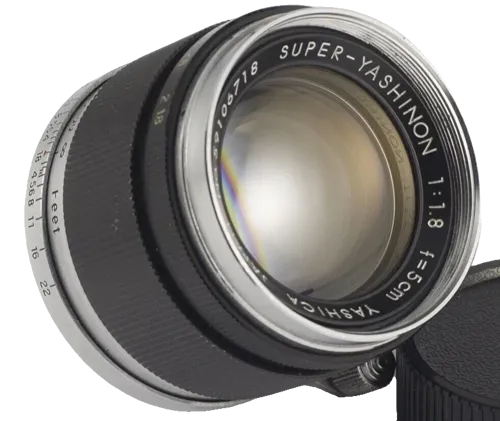
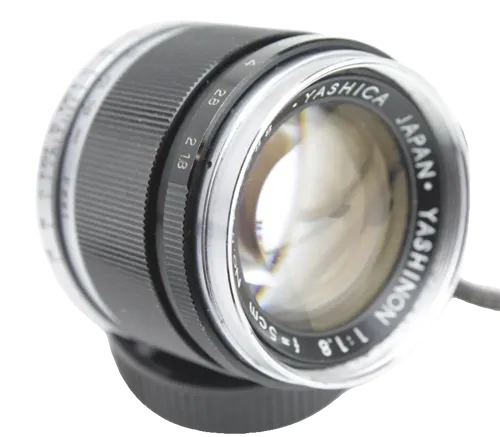
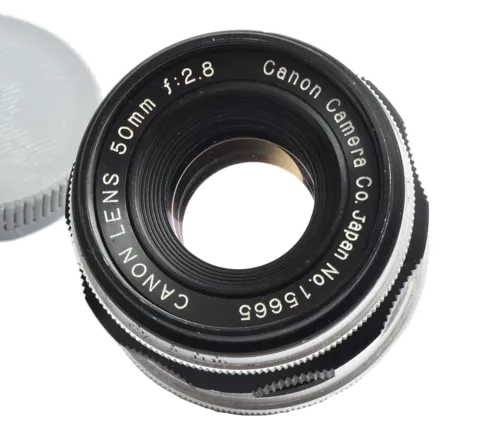
![Chiyoda Kogaku Super Rokkor 50mm f/2.8 [C]](https://assets.leicalenslist.com/images/2065_medium.webp)
Comments