The Funky Lens List: 10 Weird and Wonderful Lenses You Can Put on a Leica
Discover 10 weird and wonderful Leica lenses, from body-cap oddities and organ transplants to Cold War glass and a 740g f/1 monster.
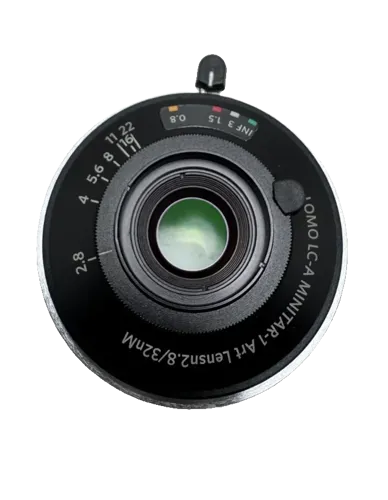
The Lomography LC-A Minitar-1 32mm f/2.8 is a pancake Leica M-mount art lens that rehouses the cult LC-A optic with rangefinder coupling.
M mount
No listings tracked for this lens right now.
The Lomography LC-A Minitar-1 f/2.8 32mm Art Lens is a M-mount lens for Leica rangefinder cameras. Leica price index →
The Minitar-1 takes the fixed lens that made the LOMO LC-A a cult compact camera and rehouses it as an interchangeable optic for Leica M rangefinders. Lomography introduced the M-mount version in 2015, presenting it as part of its line of character-driven "Art" lenses rather than as a corrected, high-resolution optic [1][3]. At 32mm and f/2.8 it sits just wider than the classic 35mm street focal length, and its extremely thin pancake body, weighing only a few tens of grams, adds almost nothing to a Leica body, effectively turning a film M into a pocketable camera.
The optical design uses five elements in four groups with multi-coating, and the construction pairs an aluminium and brass barrel with a 22.5mm filter thread. Focusing is unusual for an M-mount lens: instead of a conventional focus ring, a small protruding lever runs along a scale on the barrel with click detents at infinity, 3m, 1.5m and 0.8m, echoing the zone-focus system of the original LC-A. The lens is nonetheless rangefinder coupled, so on a Leica M it engages the camera's focusing cam for precise focus and brings up the 35mm frame lines, with the 135mm lines also triggered. Aperture is set by a loose ring with a thumb tab and no click stops, which makes it easy to nudge unintentionally while shooting. It is directly compatible with Leica M cameras, and Lomography offered adapters for mirrorless systems, some of which add a helical to allow closer focusing than the bare lens permits.
The Minitar-1 Art derives from the LC-A lineage. LOMO produced the original LC-A from 1984 to 2005, then introduced the simplified LC-A+ in 2006 with production moved to China, and the M-mount Art lens carries forward that later optic with added rangefinder coupling and manual aperture control. The lens was sold in both black and silver finishes [2 of the broader review record]. Reviewers note that the Art lens appears somewhat sharper and slightly less heavily vignetted than the optic in the original camera, attributed mainly to the ability to focus precisely with a rangefinder rather than by zone alone.
Rendering The Minitar-1 is valued for character rather than technical correction. It produces vivid, saturated color and strong contrast, with pronounced vignetting that draws the eye toward the center of the frame, reproducing the lo-fi look associated with the LC-A. It is not a sharp or aberration-free lens, and performance is best in the center, improving as the aperture is stopped down.
Sharpness Wide open the lens is soft, and close-focus performance falls off further; sharpness improves noticeably when stopped down, with the center remaining the strongest area.
Bokeh and transitions Given a 32mm focal length, f/2.8 maximum aperture and 0.8m minimum focus, depth of field is deep and there is little subject separation, so out-of-focus rendering is minimal and not the lens's purpose.
Distortion and vignetting Heavy vignetting is a defining trait, and reviewers describe distortion among the lens's deliberate quirks.
Digital use On digital M and adapted mirrorless bodies the wide rear optic can produce cyan or blue color shifts toward the edges, an effect common to symmetrical wide-angle rangefinder designs; the lens tends to suit film better, though edge color can be corrected in post.
Development and Launch The LC-A is a compact-camera legend, built by the Leningrad Optics and Mechanics Association (LOMO) between 1984 and 2005 as a simplified derivative of the Cosina CX-2, and its fixed 32mm f/2.8 Minitar lens was central to its fame. LOMO ended classic LC-A production in 2005 and launched the LC-A+ in 2006 with production relocated to China and manual aperture selection removed. The interchangeable M-mount Minitar-1 Art lens was announced by Lomography in 2015, extracting the LC-A's optic into a standalone rangefinder lens.
Production Evolution The Art lens uses the later LC-A optic and adds rangefinder coupling and manual aperture control not present on the camera. Independent reviewers note the Art lens can render with more apparent sharpness than the original; whether this reflects an optical reformulation when production restarted in China or simply the benefit of precise rangefinder focusing is not settled, with the latter the more likely explanation.
Collector Notes Buyers should confirm the desired finish, as the lens was offered in black and silver. Because the aperture ring has no detents and is relatively loose, it can shift during use and is worth checking on a used sample. The zone-focus lever and detents are part of the design and not a fault, and on a Leica the lens brings up the 35mm frame lines while imaging slightly wider than 35mm, so framing is a little tighter than the actual coverage. Original examples typically ship with a marked 22.5mm threaded cap and Lomography's documentation booklet.
Similar lenses you might be interested in
Comments