Best price Good
Leica Summilux-M 1,4/75mm 11815
Sold by classic.leica-camera.com
€3,118 ≈ $3,367
The Leica Summilux-M 75mm f/1.4 II is a fast Walter Mandler portrait lens in M mount, prized by collectors for glowing wide-open rendering and warm color.
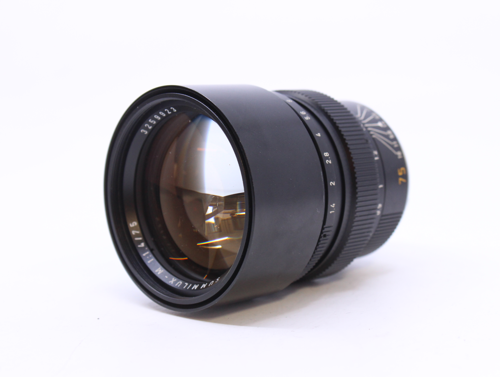
M mount
The Leica Summilux-M 75mm f/1.4 II is a M-mount lens for Leica rangefinder cameras. As of October 2026, it sells from €3,138 used across 4 listings, with a 30-day median of €3,609. Leica price index →
Measured against the 17 other 75mm M-mount lenses in the catalogue.
Among fast Leica M portrait lenses, the 75mm Summilux occupies a place that owes more to its drawing character than to chart performance, and the f/1.4 maximum aperture on a short telephoto gives it a distinctive shallow depth of field at close range. The lens was designed by Walter Mandler, the optical engineer also responsible for the 50mm Noctilux, and the 75mm is widely described as one of Mandler's own favorite designs [1][2]. Its optical layout is generally regarded as a derivative of the 50mm Noctilux of the period, sharing the family traits of a soft, luminous wide-open look and smooth out-of-focus rendering rather than clinical correction.
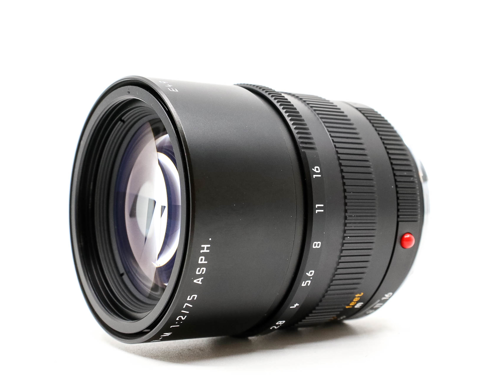
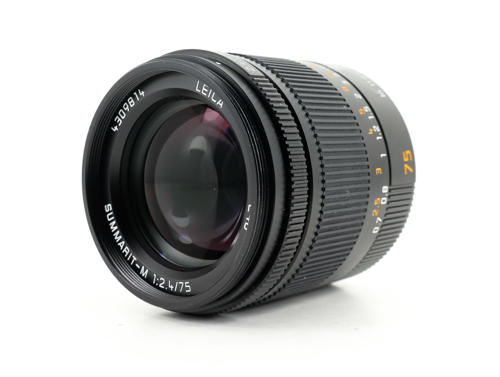
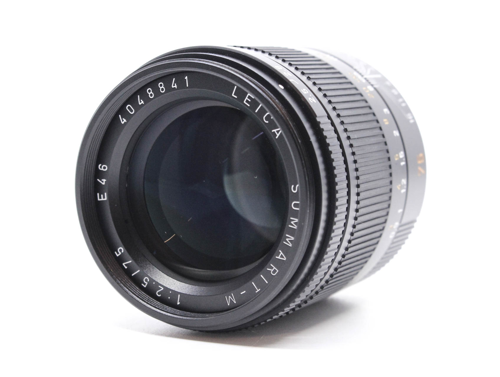
The lens uses seven elements in five groups with a ten-blade diaphragm, and it does not employ an aspherical element. The barrel is built to the usual Leica standard, compact but dense in the hand, with a well-damped focus ring and an aperture ring that clicks at half-stop detents. The version covered here, model 11815, carries a built-in retractable hood and a 60mm (E60) filter thread, and it focuses closer than its earlier sibling. As an M-mount lens it is rangefinder coupled, and the front does not rotate during focus, which is convenient for filter use. Reviewers note that the focusing experience suits deliberate portrait and shallow depth of field work, and that the lens exhibits moderate focus shift as it is stopped down, a behavior easier to manage on mirrorless bodies with magnified focusing than on a coupled rangefinder.
The 75mm Summilux ran in three closely related forms over a long production life. The first, model 11814 introduced in 1980, was the lightest, used a 58mm filter thread, had a separate detachable hood, and focused to roughly one meter. Model 11815, introduced in 1982 to replace it, added the 60mm thread and built-in sliding hood, focused closer, and was manufactured in Canada; it is the most commonly encountered version. A later model, 11810, introduced in 1998 and made in Germany, looks essentially identical to the 11815 but is somewhat lighter, and it commands a modest premium among buyers. All three are reported to share the same optical formula, with the published differences confined to barrel construction, hood type, weight and minimum focus, although some users speculate about coating tweaks across the long run without confirmed documentation. A closely related sibling exists in the SLR Leica R line as the Summilux-R 80mm f/1.4, which is larger but shares the rendering signature.
Rendering The 75mm Summilux is valued for a rendering that combines softness with rich, saturated color, often described as a glow at wide apertures. Wide open it trades outright resolution for atmosphere, then transitions toward a more conventional, well-corrected look as it is stopped down.
Sharpness Reviewers consistently report that at f/1.4 the lens is sharp only in the central area, blanketed by spherical aberration across the rest of the frame, with a marked improvement at f/2 and strong, biting sharpness from about f/2.8 to f/8. By the middle apertures it easily resolves a 24-megapixel sensor, making it capable for general work once stopped down.
Contrast and color The lens is described as warm, leaning toward red and green, with colors that read as vibrant yet gentle; one detailed comparison found its wide-open saturation similar to a modern contrasty lens despite the softer micro-detail.
Bokeh and transitions Background blur is generally smooth and considered a strength for portraits, with f/2 often cited as a sweet spot, though the ten unrounded blades produce angular highlights when stopped down, and mechanical vignetting yields pronounced cat's-eye shapes toward the edges wide open.
Flare resistance As expected of a fast lens of its era, flare control is modest, and strong or off-axis light can introduce ghosting and veiling that reduce contrast; stopping down changes but does not eliminate it.
Aberrations Both longitudinal and lateral chromatic aberration are present, with visible color fringing in out-of-focus areas, a trait noted across several Mandler designs, alongside the moderate focus shift mentioned above.
Development and Launch The 75mm Summilux-M was introduced in 1980 as a fast short telephoto aimed at portraiture and low-light shooting, sitting between the 50mm and 90mm focal lengths in the M lineup. Its design by Walter Mandler drew on the optical approach of the contemporaneous 50mm Noctilux, prioritizing rendering character over maximum measured correction.
Production Evolution The original 11814 was followed in 1982 by the 11815, which changed the filter thread to 60mm, added a built-in retractable hood, increased weight, and shortened the minimum focus distance. In 1998 the German-made 11810 replaced it, lighter than the Canadian version but otherwise matched in hood and focusing, and the line was eventually discontinued in 2007 when the 75mm focal length later passed to the 75mm f/1.25 Noctilux-M ASPH.
Special editions No widely documented factory special editions, military or regional variants of this lens are commonly reported; the principal differences across its life are the three standard production models and the parallel Summilux-R 80mm f/1.4 in the SLR mount.
Collector Notes Buyers can distinguish the 11815 by its 60mm (E60) filter thread and built-in sliding hood, features that separate it from the earlier 58mm-thread 11814 and that it shares visually with the later German 11810. Country of manufacture, weight and packaging help confirm which version a copy is. The matching cap is the E60 type, and the built-in hood should slide and lock without creeping. Prospective buyers should check focusing for the lens's known focus shift and inspect for haze or coating wear given the age of these optics. One point worth noting: published references generally place the end of production around 2007, whereas this catalogue entry lists the production span as open-ended, so the stated dates should be read with that distinction in mind.
Good time to buy. The lowest listing is 13% below the 30-day average.
Lowest price Click a mark to open that listing · arrow keys to step, Enter to open
Price against condition for 4 listings of Leica Summilux-M 75mm f/1.4 II, €3,118 to €3,736, median €3,492. Excellent: 1 at €3,398. Good: 1 at €3,118. Used: 2 at €3,586, €3,736. The full table follows.
| Condition | Lowest | Median |
|---|---|---|
| Excellent | €3,398 | €3,398 |
| Good | €3,118 | €3,118 |
| Other | €3,586 | €3,661 |
Over the last 18 weeks the median price for the Leica Summilux-M 75mm f/1.4 II has fallen, ranging from €3,171 to €3,658 (now €3,609).
Weekly price (EUR). Median (Good or better) and lowest (Good or better) across 18 weeks. The full figures follow in the table below.
| Week | Median | Lowest |
|---|---|---|
| Jun 1, 2026 | €3,204 | €2,838 |
| Jun 8, 2026 | €3,204 | €2,838 |
| Jun 15, 2026 | €3,182 | €2,838 |
| Jun 22, 2026 | €3,161 | €2,838 |
| Jun 29, 2026 | €3,166 | €2,838 |
| Jul 6, 2026 | €3,171 | €2,838 |
| Jul 13, 2026 | €3,171 | €2,838 |
| Jul 20, 2026 | €3,171 | €3,161 |
| Jul 27, 2026 | €3,171 | €2,960 |
| Aug 3, 2026 | €3,171 | €2,960 |
| Aug 10, 2026 | €3,171 | €2,960 |
| Aug 17, 2026 | €3,241 | €2,960 |
| Aug 24, 2026 | €3,171 | €2,960 |
| Aug 31, 2026 | €3,171 | €2,960 |
| Sep 7, 2026 | €3,161 | €2,960 |
| Sep 14, 2026 | €3,166 | €2,960 |
| Sep 21, 2026 | €3,166 | €2,960 |
| Sep 28, 2026 | €3,268 | €3,138 |
Every shop grades differently. Leica Classic uses letters, Ffordes uses E++ and E+, German dealers write "Zustand B", Japanese dealers write A−. We map all of them onto the one ladder below. Where a shop states its own grade, we print it under ours.
As of October 2026, the Leica Summilux-M 75mm f/1.4 II sells from €3,138 used, with a 30-day median of €3,609, across 4 active listings.
As of October 2026, the Leica Summilux-M 75mm f/1.4 II is sold by 3 sources (4 listings), from €3,138 used: all compared cheapest-first on this page.
Similar lenses you might be interested in
Comments