Best price Fair
Leica Summilux-M 1.4/75mm V1 (11814)
Sold by classic.leica-camera.com
€2,900 ≈ $3,132
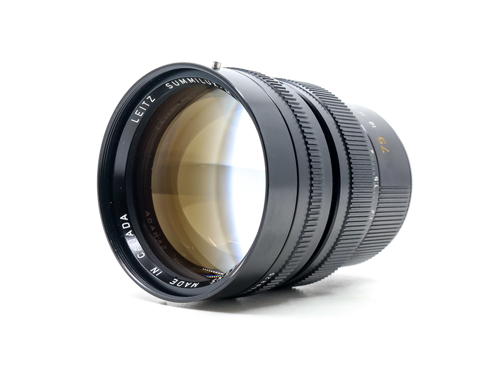
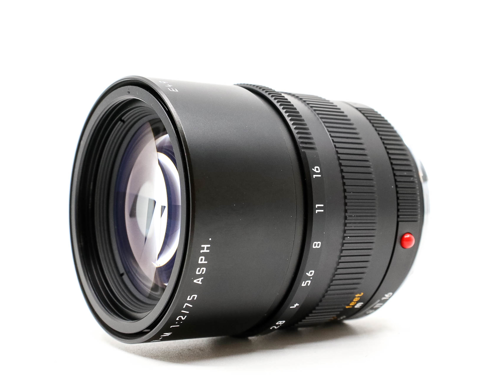
The Leica Summilux-M 75mm f/1.4 I is the original Canadian-made fast short telephoto for M-mount, a Walter Mandler design prized by portrait shooters and collectors.
M mount
The Leica Summilux-M 75mm f/1.4 I is a M-mount lens for Leica rangefinder cameras. As of October 2026, it sells from €2,900 used across 8 listings, with a 30-day median of €3,758. Leica price index →
Measured against the 17 other 75mm M-mount lenses in the catalogue.
The 75mm Summilux-M f/1.4 was Leica's bid to put a very fast short telephoto onto the rangefinder, and the first version is the one that started a long and well documented production run. It was designed by Walter Mandler at Leitz Canada and is frequently described as one of his personal favourite designs, a reputation that has followed the lens through decades of collector and user discussion [1][3]. The optical formula uses seven elements arranged in groups, without an aspherical surface, and Mandler's approach gives the lens the blend of usable wide-open speed and distinctive rendering that made it sought after for portraiture [2]. This earliest variant carried the Leica order number 11814, was made in Canada, and is the lightest and most compact of the three production versions.
As an M-bayonet lens it is rangefinder coupled and works directly on film and digital M bodies without an adapter. Build is typical Leitz, compact but dense in the hand, with a well damped focus ring and a clearly detented aperture ring; the manual focusing helicoid extends the barrel as it racks toward closer distances. It is not six-bit coded from the factory, so users of later digital M cameras commonly have a code applied or select the profile manually for in-camera correction. The first version takes E60 filters and was supplied with a separate vented hood rather than the built-in retractable hood that appeared on later versions.
Identifying this first version is mostly a matter of the engraving, the order number, the country of manufacture, and the detachable hood. The lens was made in Canada and is inscribed accordingly, whereas the later Version III was built in Germany. The most visible change across the run was the move from the first version's removable hood to a built-in retractable hood on the second and third versions, with the German-made final version being the one that commands a modest premium among buyers. Reviewers note that while different production runs are sometimes said to vary in rendering, there is no published manufacturer documentation confirming changes to the optical formula, and any differences are more plausibly attributed to coating tweaks over time.
Rendering The 75 Summilux is valued for its rendering rather than for clinical correction, and that character is strongest from f/1.4 to about f/2, the range most associated with its portrait reputation. Wide open the centre is sharp while spherical aberration spreads a soft glow across the frame, lending images a gentle, luminous quality even though fine texture is partly veiled; stopping down progressively cleans this up, with strong cross-frame performance arriving by the middle apertures. Colour is generally described as rich and warm, leaning toward red and green, which contributes to the look users associate with the lens.
Bokeh and transitions Background blur is smooth at the lens's portrait sweet spot, though wide open the rendering can be busier and shows mechanical, cat's-eye shaped out-of-focus highlights toward the frame edges, a trait reviewers link in part to the relatively narrow 60mm filter throat.
Flare resistance As with many fast lenses of its era, flare control is modest by modern standards, and strong backlight can introduce ghosting and veiling that reduce contrast; stopping down changes the shape of the artefacts more than it removes them.
Aberrations Chromatic aberration is present wide open and is broadly in line with other fast lenses of the period, diminishing noticeably by f/2. The design is not corrected for close distances and shows increased spherical aberration at its nearest focus, which some shooters use deliberately for effect.
Development and Launch The lens was introduced in 1980 and was designed by Walter Mandler at Leitz Canada, the plant established after the Second World War so that Leica could maintain production independently of Wetzlar. It gave M photographers a fast short telephoto suited to portraiture and shallow depth of field, and it remained in the catalogue until 2007, after which Leica's fast 75mm line was eventually continued by the 75mm Noctilux f/1.25. A closely related sibling, the Summilux-R 80mm f/1.4 for the reflex system, shares the same basic optical concept.
Production Evolution Across its run the lens passed through three principal versions. Version I (11814) was made in Canada with a removable vented hood; Version II, also Canadian, adopted a built-in retractable hood; and the final Version III (11810) was produced in Germany. All three retain the same E60 filter size and the seven-element layout, and the most consequential visible change is the hood arrangement; documented optical-formula changes are not established, though coating variations over the long production span are plausible.
Special editions Collector references record special and variant builds associated with the 75 Summilux family, including titanium and anniversary-related editions noted in Leica reference material, alongside the standard black finish that defines the common production lenses. No widely documented military or export-only factory variant of the first version is established beyond these.
Collector Notes For the first version, confirm the Canadian manufacture engraving, the 11814 order number, and the presence of the separate vented hood (Leica 12539), since later versions used a built-in hood and the German-made final version differs in finish and weight. As a fast lens that is no longer in production, clean copies trade at high prices, so buyers should check glass for haze and cleaning marks and verify that the focus and detented aperture mechanisms operate correctly. Note also that a single discrepancy exists in published sources over the first version's close-focus and weight figures, with some references citing slightly different values than others; the figures recorded by LeicaLensList should be taken as authoritative.
Good time to buy. The lowest listing is 23% below the 30-day average.
Lowest price Click a mark to open that listing · arrow keys to step, Enter to open
Price against condition for 8 listings of Leica Summilux-M 75mm f/1.4 I, €2,900 to €5,522, median €4,578. Excellent: 5 at €3,529, €5,168, €5,168, €5,286, €5,522. Good: 2 at €3,316, €3,988. Fair: 1 at €2,900. The full table follows.
| Condition | Lowest | Median |
|---|---|---|
| Excellent | €3,529 | €5,168 |
| Good | €3,316 | €3,652 |
| Fair | €2,900 | €2,900 |
Over the last 17 weeks the median price for the Leica Summilux-M 75mm f/1.4 I has fallen, ranging from €3,166 to €5,170 (now €3,758).
Weekly price (EUR). Median (Good or better) and lowest (Good or better) across 17 weeks. The full figures follow in the table below.
| Week | Median | Lowest |
|---|---|---|
| Jun 1, 2026 | €3,805 | €3,805 |
| Jun 8, 2026 | €3,805 | €3,805 |
| Jun 15, 2026 | €3,166 | €3,166 |
| Jun 22, 2026 | €3,166 | €3,166 |
| Jul 6, 2026 | €3,388 | €3,388 |
| Jul 13, 2026 | €3,388 | €3,388 |
| Jul 20, 2026 | €3,388 | €3,388 |
| Jul 27, 2026 | €3,246 | €3,105 |
| Aug 3, 2026 | €5,170 | €3,105 |
| Aug 10, 2026 | €4,580 | €3,105 |
| Aug 17, 2026 | €4,580 | €3,105 |
| Aug 24, 2026 | €3,990 | €3,105 |
| Aug 31, 2026 | €4,580 | €3,121 |
| Sep 7, 2026 | €5,170 | €3,121 |
| Sep 14, 2026 | €5,170 | €3,121 |
| Sep 21, 2026 | €5,170 | €3,121 |
| Sep 28, 2026 | €5,168 | €3,316 |
Every shop grades differently. Leica Classic uses letters, Ffordes uses E++ and E+, German dealers write "Zustand B", Japanese dealers write A−. We map all of them onto the one ladder below. Where a shop states its own grade, we print it under ours.
As of October 2026, the Leica Summilux-M 75mm f/1.4 I sells from €2,900 used, with a 30-day median of €3,758, across 8 active listings.
As of October 2026, the Leica Summilux-M 75mm f/1.4 I is sold by 2 sources (8 listings), from €2,900 used: all compared cheapest-first on this page.
Similar lenses you might be interested in
Comments