Best price Official store New
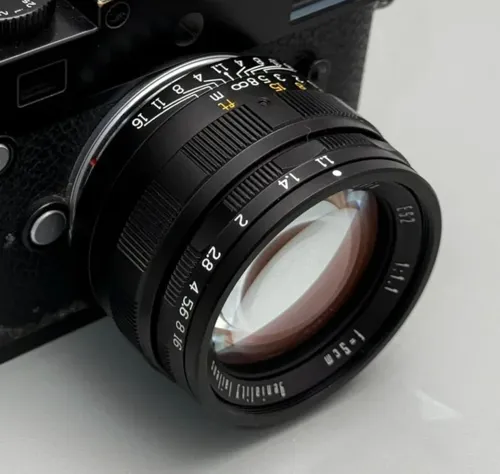
ARTRA LAB 50mm F1.1 LUNAELUMEN-M Camera Lens for Leica M-Mount Version 3
Sold by Artra Lab
€359 ≈ $388
Coupon code LEICALENSLIST: 5% off at Artra Lab for the Artralab 50mm f/1.1 Lunaelumen-M V3.
Copied!
The Artralab 50mm f/1.1 Lunaelumen-M V3 is a fast manual M-mount prime, a low-cost large-aperture fifty drawing interest from Leica and mirrorless shooters.
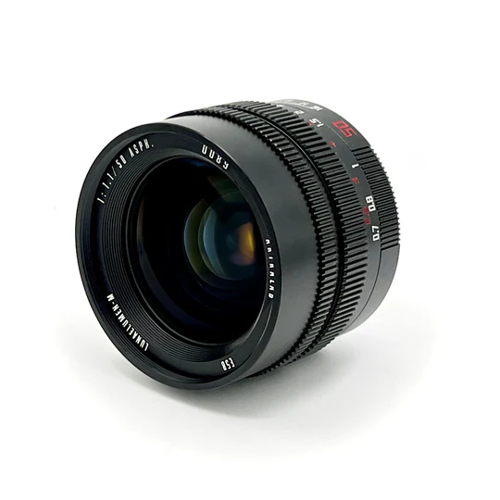
M mount
The Artralab 50mm f/1.1 Lunaelumen-M V3 is a M-mount lens for Leica rangefinder cameras. As of October 2026, it sells from €359 used across 1 listing, with a 30-day median of €359. Leica price index →
Measured against the 76 other 50mm M-mount lenses in the catalogue.
The Lunaelumen-M is part of a wave of inexpensive, large-aperture manual lenses from smaller Asian makers aimed at photographers who want a fast fifty without the cost of a Leica Noctilux or Voigtlander option. Artra Lab, a Hong Kong based brand, markets this version as the third iteration of its Lunaelumen line, built specifically for the Leica M system [1]. Its appeal rests largely on the combination of an f/1.1 maximum aperture, an all-metal barrel, and a price that sits far below comparable rangefinder-coupled fast normals, which has drawn attention from both Leica users and mirrorless shooters who adapt M-mount glass [2].
Optically the lens uses an 8-element, 6-group design and an 11-blade diaphragm, with a low-reflective multilayer coating named by the maker, an aluminium-alloy body, and a brass mount. It covers the full-frame 50mm field of view, focuses to 0.7 m, and takes 58mm filters. The barrel is purely mechanical, with a smooth manual focus ring and a click or de-clicked aperture depending on configuration; reviewers of the sibling versions describe the focus action as light and the aperture as somewhat heavily damped [3]. The M-mount Lunaelumen is not rangefinder coupled, so on a Leica it is focused by estimation or via live view on digital bodies, and Artra Lab notes that focus calibration may be needed because of the rangefinder mechanism. On mirrorless cameras the lens can also be used with a focusing adapter for additional close-focus and, with some adapters, autofocus support.
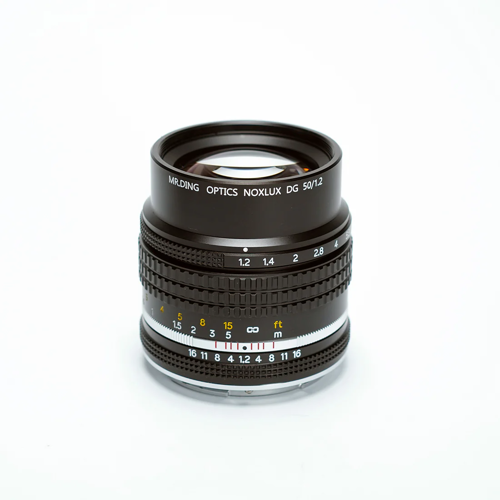
The Lunaelumen is sold in several mounts, including Leica M and Nikon Z, with the Z-mount variant differing in physical dimensions and rear intercept while sharing the same optical concept. The same 8-element, 6-group formula and 11-blade aperture appear on closely related lenses sold under other names, including the Dr. Ding Optics Noxlux-M 50mm f/1.1 and various unbranded clones, which a forum tester found to be physically identical apart from casing and branding. Buyers should therefore expect to find near-identical optics under different labels at varying prices.
Rendering Documented testing of the Lunaelumen line, mostly of the Z-mount version, describes a lens with strong vintage character wide open and improving sharpness on stopping down. The maker promotes smooth bokeh from the 11 rounded blades and a classic look that blends vintage and modern traits.
Sharpness Reviewers report softness at f/1.1 that is usable rather than unusable, with images sharpening noticeably by about f2.8 and clearly sharp beyond it. The wide-open softness is part of the lens's intended character.
Bokeh and transitions The rounded 11-blade diaphragm and fast aperture produce creamy out-of-focus rendering that reviewers cite as a main strength, well suited to portraits and low-light work.
Contrast and color Testing of the Z-mount version noted accurate color and a lower-contrast, film-era look attributed to the coatings, with users advised that adding contrast in post can help.
Flare resistance Flare control was described as decent in one review, though aperture-shaped sun flare could appear in some frames.
Distortion and vignetting The same review noted that vignetting becomes quite noticeable when the lens hood is fitted.
Digital use Because the M-mount version lacks rangefinder coupling, it is most practical on digital bodies with live view or on mirrorless cameras using an M adapter, where focusing aids make wide-open work easier.
Development and Launch Artra Lab introduced the Lunaelumen as one of several affordable manual lenses, alongside its NoNikkor primes, marketing the 50mm f/1.1 as an accessible fast normal with retro styling. The V3 M-mount lens is described by the maker as the third version of the line and remains in current production.
Production Evolution The Lunaelumen has appeared in multiple mount versions, with the Leica M and Nikon Z editions differing in barrel dimensions while retaining the shared optical design. Detailed records of internal optical or coating revisions across the V1 to V3 sequence are not well documented in independent sources.
Special editions No widely documented factory special editions, military variants, or rare finishes are recorded for this lens. It is, however, closely related to rebadged versions such as the Dr. Ding Optics Noxlux-M and unbranded clones that share its optical block.
Collector Notes As a current, mass-produced lens rather than a vintage rarity, the Lunaelumen-M has limited collector scarcity. Prospective buyers should be aware that near-identical optics are sold under several names and at different prices, so comparing the M-mount Artra Lab unit against clones such as the Noxlux-M can affect value. Because the lens is not rangefinder coupled, focus calibration may be required on rangefinder bodies, and accurate wide-open focusing generally depends on live view or a mirrorless adapter. Note that the maker lists a body weight figure for the M-mount V3 that differs from the heavier weight published for the Z-mount review sample, reflecting the different mount and barrel.
About the usual price. The lowest listing is around the 30-day average.
Official-store listings are affiliate links: buying through them supports Leica Lens List at no extra cost to you.
Over the last 9 weeks the median price for the Artralab 50mm f/1.1 Lunaelumen-M V3 has held steady, ranging from €359 to €359 (now €359).
Weekly price (EUR). Median (Good or better) and lowest (Good or better) across 9 weeks. The full figures follow in the table below.
| Week | Median | Lowest |
|---|---|---|
| Aug 3, 2026 | €359 | €359 |
| Aug 10, 2026 | €359 | €359 |
| Aug 17, 2026 | €359 | €359 |
| Aug 24, 2026 | €359 | €359 |
| Aug 31, 2026 | €359 | €359 |
| Sep 7, 2026 | €359 | €359 |
| Sep 14, 2026 | €359 | €359 |
| Sep 21, 2026 | €359 | €359 |
| Sep 28, 2026 | €359 | €359 |
Official store Official-store listings are affiliate links. Buying through one supports Leica Lens List at no extra cost to you, and never changes where a listing sits in this table.
Every shop grades differently. Leica Classic uses letters, Ffordes uses E++ and E+, German dealers write "Zustand B", Japanese dealers write A−. We map all of them onto the one ladder below. Where a shop states its own grade, we print it under ours.
As of October 2026, the Artralab 50mm f/1.1 Lunaelumen-M V3 sells from €359 used, with a 30-day median of €359, across 1 active listing.
As of October 2026, the Artralab 50mm f/1.1 Lunaelumen-M V3 is sold by 1 source (1 listing), from €359 used: all compared cheapest-first on this page.
Similar lenses you might be interested in

Comments