An early-1950s Angénieux Type P1 90mm f/1.8 portrait lens with five elements in four groups, coupled LTM focusing and a 1m near limit.
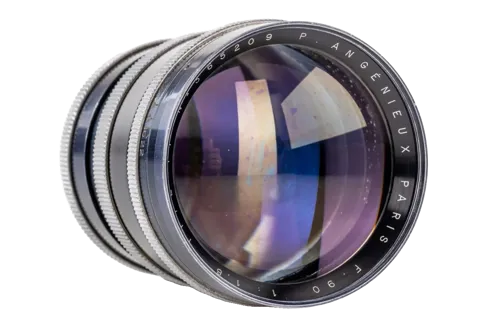
Angénieux Type P1 90mm f/1.8
LTM mount
No listings tracked for this lens right now.
The Angénieux Type P1 90mm f/1.8 is a LTM-mount lens for Leica rangefinder cameras. Leica price index →
How it compares
Measured against the 14 other 90mm LTM-mount lenses in the catalogue.
Specification
About this lens
Angénieux Type P1 90mm f/1.8
The Angénieux Type P1 90mm f/1.8 is a very fast French short telephoto made in an original, rangefinder-coupled Leica screw-mount version. Specialist records identify five elements in four groups, a minimum focusing distance around 1 metre and a large 56mm front fitting. The profile covers the factory coupled LTM construction, not Type P1 optical heads subsequently adapted from reflex-camera mounts.
Reliable surviving examples place the screw-mount version in the early 1950s. Flashback Camera documents factory Leica-thread examples from 1953, while Leitz Auction records an original coupled lens manufactured in 1954. These dates verify period production, but they do not by themselves prove that every Type P1 mount version was launched in the same year.
Optical qualities
Rendering
The Type P1 is documented with five elements in four groups, often described as an Ernostar-derived fast telephoto arrangement. The design combines a 90mm focal length with an unusually bright f/1.8 aperture for its period. No factory modulation or field-curvature data for the exact LTM version has been located, so the entry does not assign universal modern performance scores.
At portrait distances, the focal length provides a narrow field and a comfortable camera position. The long focal length and large aperture make selective focus easy to see. Haze, coating damage, separation or incorrect reassembly can substantially lower contrast.
At f/1.8
Depth of field is shallow at close range and places a high demand on the coupling cam, camera rangefinder and photographer. Focus should be checked on the intended point of detail rather than on a nearby eyelash or frame edge. Calibration at infinity alone is insufficient because a cam can agree at one distance and drift at another.
Reports based on individual Type P1 copies often describe lower contrast or gentler detail at maximum aperture, but sample variation prevents that from being treated as a guaranteed aesthetic. A hood can improve resistance to oblique light. It cannot compensate for damaged coatings or internal contamination.
Stopped down
Closing the aperture increases depth of field and normally improves consistency across the image. Middle settings are useful when both eyes or a wider portrait plane must remain defined. The smallest aperture and diaphragm blade count are not stated here because figures published for Exakta or other barrels may not apply to every original coupled LTM example.
Handling and compatibility
The original screw-mount barrel couples to a calibrated Leica-standard rangefinder. At 90mm, many bodies require an accessory finder or a built-in 90mm frame for accurate composition. The recorded 1m near limit is ambitious for a period rangefinder telephoto and should be tested with the actual focusing scale and cam.
The 56mm filter fitting gives the lens a substantial front profile. Filter and hood threads should be checked before forcing a modern accessory, since pitch and retaining-ring details are not established by diameter alone. An LTM-to-M adapter enables use on compatible Leica M bodies, while mirrorless adaptation provides direct sensor focus for condition testing.
History
Development and Launch
Angénieux was founded in Paris in 1935 and developed photographic, cinema and specialised optical products. The Type P1 belongs to its postwar still-camera prime range, before zoom lenses became the firm's dominant public identity. Its f/1.8 maximum aperture placed it among the fastest 90mm photographic lenses of its era.
The exact first sales month has not been verified in a factory catalogue. A factory Leica screw-mount example documented by Flashback Camera dates from 1953, and Leitz Auction identifies a rare original rangefinder-coupled example from 1954. The LeicaLensList release field gives the broader early-1950s period rather than presenting either surviving copy as the first lens made.
Production Evolution
Type P1 lenses were also manufactured for reflex systems, including Exakta, and examples survive in other mechanical mounts. Those lenses can share the five-element, four-group optical family while differing in register, focusing mount, scale, aperture control and rangefinder compatibility. A change of mount is therefore not merely decorative in practical use.
Original coupled LTM examples are established by specialist and auction documentation. Modern conversions of reflex-mount Type P1 lenses should remain identified as conversions. A conversion may focus accurately and preserve the optical head, but it does not acquire the production history of the factory screw-mount barrel.
Special Editions/Variants
No commemorative Type P1 edition is known. Metre and feet scales and minor exterior revisions occur across the wider production family. These do not justify separate optical profiles without evidence of a recalculation or materially different factory mechanism.
Collector Notes
Confirm the P. Angénieux Paris, Type P1 and 90mm f/1.8 engravings together with the original screw thread, coupled cam and coherent factory barrel construction. Examine any lens offered for Leica use for adapter seams, replaced focusing mounts or mismatched serial-bearing parts. Functional classification is more reliable than seller wording alone.
Test rangefinder agreement at infinity, intermediate distance and near 1m. Inspect the large elements for haze, fungus, separation, coating wear and cleaning damage. Check diaphragm operation and helicoid stability. Serial numbers, accessories, auction grades and prices belong to individual examples and are excluded from the generic profile.
Sources
- Angénieux, company history timelineangenieux.com →
- Leitz Auction, original coupled Angénieux Type P1 90mm f/1.8leitz-auction.com →
- Flashback Camera, Angénieux Type P1 90mm f/1.8 in Leica screw mountflashbackcamera.jp →
- Flashback Camera, early Type P1 factory Leica screw-mount versionflashbackcamera.jp →
Where to buy
Related lenses
Similar lenses you might be interested in
Comments