Best price Excellent
Orion-15 28mm f/6 in Leica screw mount
Sold by Fotohandel Delfshaven
€319 ≈ $344
The ZOMZ Orion-15 28mm f/6 is a compact Soviet, rangefinder-coupled LTM wide-angle lens with four-element Topogon-type optics and low distortion.
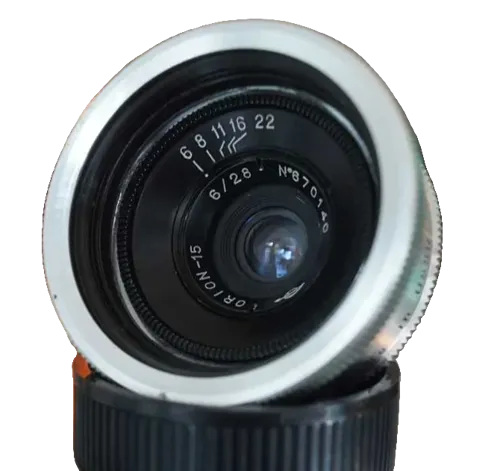
M39 mount
The ZOMZ Orion-15 28mm f/6 LTM is a M39-mount lens for Leica rangefinder cameras. As of September 2026, it sells from €319 used across 1 listing, with a 30-day median of €319. Leica price index →
The ZOMZ Orion-15 28mm f/6 is a compact Soviet wide-angle lens made in Leica screw mount for 35mm rangefinder cameras. It belongs to the small group of Soviet wide-angle lenses for FED, Zorki and Leica-thread-mount cameras, alongside lenses such as the Russar MR-2 20mm f/5.6 and Jupiter-12 35mm f/2.8. AllPhotoLenses lists the Orion-15 as a 35mm rangefinder lens available in Contax / Kiev mount and M39 Leica screw mount, with first production year 1956 and a 4 element, 4 group Topogon-type optical design .
The lens is slow but extremely compact. Published specifications list a 28mm focal length, f/6 to f/22 aperture range, 7 aperture blades, 1m closest focusing distance, 40.5mm filter thread, 80g weight and 30mm length. Shige’s review also records 4 elements in 4 groups, 7 aperture blades, 1m closest focus, Leica L39 / M rangefinder linkage to 1m and 40.5mm filter compatibility .
This entry covers the Leica screw-mount LTM / M39 rangefinder-coupled version. The Orion-15 was also made in Kiev / Contax rangefinder mount, and prototype or pre-series examples exist. The Leica screw-mount version should be kept separate from the Contax / Kiev bayonet version. Leitz Auction documents a Zagorsk M39 Orion-15 6/28mm as a rangefinder-coupled M39 wide-angle lens .
Rendering
The Orion-15 is a Topogon-type symmetrical wide-angle lens. Its rendering is generally associated with low distortion, high depth of field and strong compact-lens usability rather than speed or subject separation. AllPhotoLenses states that the lens was designed on the basis of the Topogon scheme and notes high resolution and large depth of field.
Sharpness
The lens has a reputation for good central sharpness, especially considering its small size and simple 4 element construction. AllPhotoLenses lists resolution figures of 55 / 34 / 26 lpmm at 0mm, 10mm and 20mm from the center, with technical specification resolution of 45 / 18 lpmm center / edge. User reports vary, especially at the edges on digital bodies, so copy condition and calibration remain important.
Contrast and color
The Orion-15 is single-coated. AllPhotoLenses describes it as having single-layer chemical coating. Contrast can be good when the optics are clean, but haze, cleaning marks, coating wear and internal reflections can reduce performance on surviving examples.
Distortion and vignetting
Low distortion is one of the design’s main documented strengths. Shige’s review notes that the lens gives almost no visible distortion when photographing buildings, consistent with the symmetrical Topogon-type layout. Vignetting is more visible, and AllPhotoLenses lists geometric vignetting at 67 percent.
Digital use
The lens can be used on Leica M bodies with an L39-to-M adapter and on mirrorless cameras with suitable adapters. Skyllaney notes that some Soviet rangefinder lenses may be calibrated to Zorki rather than Leica rangefinder standards, and describes recalibrating an Orion-15 from Zorki calibration to Leica calibration for better close-distance focusing on digital Leica bodies . This means rangefinder accuracy should be checked on the exact camera and adapter combination.
Development and Launch
The Orion-15 traces back to Soviet optical development around the Topogon wide-angle concept. Sovietcams records a GOI-calculated prototype from 1944, with very few early lenses released in 1944 to 1949 in Kiev / Contax mount, followed by KMZ prototype and pre-series examples in the 1950s . AllPhotoLenses lists 1956 as the first production year for the Orion-15 rangefinder lens and records both Contax and M39 Leica screw-mount versions.
Production Evolution
Production history is not fully uniform across sources. Shige’s review states that prototypes began in the 1940s, mass production took place at KMZ during the 1950s, and production later transferred to ZOMZ, where it is said to have continued until the late 1970s. Spiral-M42 gives a similar account, noting GOI development, KMZ production and later ZOMZ production, with observed serial numbers suggesting manufacture at least into 1978 . Because the exact final year is not firmly documented, the database production end year should remain Unknown.
Special Editions/Variants
No commemorative factory special edition is widely documented. Collector-relevant variants are factory and mount variants: early GOI / KMZ prototype or pre-series lenses, KMZ production, ZOMZ / Zagorsk production, M39 Leica screw-mount versions, Kiev / Contax bayonet versions and rare black-finish examples. Factory attribution should follow the mark on the lens whenever possible.
Collector Notes
Collectors should verify the factory mark, serial number, M39 mount, rangefinder coupling, infinity focus, aperture ring movement, filter thread, optical cleanliness and whether the lens includes the original Bakelite keeper or caps. Because the aperture is adjusted from the front and the filter thread is recessed, using filters can make aperture adjustment awkward. Shige notes that attaching a 40.5mm filter can block easy aperture adjustment on some examples. Buyers should also check whether the lens is calibrated for Leica rangefinder use, especially if it will be used on a digital Leica M body.
About the usual price. The lowest listing is around the 30-day average.
Over the last 14 weeks the median price for the ZOMZ Orion-15 28mm f/6 LTM has risen, ranging from €316 to €325 (now €319).
Weekly price (EUR). Median (Good or better) and lowest (Good or better) across 14 weeks. The full figures follow in the table below.
| Week | Median | Lowest |
|---|---|---|
| Jun 15, 2026 | €319 | €319 |
| Jun 22, 2026 | €319 | €319 |
| Jun 29, 2026 | €319 | €319 |
| Jul 6, 2026 | €317 | €317 |
| Jul 13, 2026 | €317 | €317 |
| Jul 20, 2026 | €316 | €316 |
| Jul 27, 2026 | €319 | €319 |
| Aug 3, 2026 | €320 | €320 |
| Aug 10, 2026 | €321 | €321 |
| Aug 17, 2026 | €325 | €325 |
| Aug 24, 2026 | €323 | €323 |
| Aug 31, 2026 | €323 | €323 |
| Sep 7, 2026 | €322 | €322 |
| Sep 14, 2026 | €319 | €319 |
Every shop grades differently. Leica Classic uses letters, Ffordes uses E++ and E+, German dealers write "Zustand B", Japanese dealers write A−. We map all of them onto the one ladder below. Where a shop states its own grade, we print it under ours.
As of September 2026, the ZOMZ Orion-15 28mm f/6 LTM sells from €319 used, with a 30-day median of €319, across 1 active listing.
As of September 2026, the ZOMZ Orion-15 28mm f/6 LTM is sold by 1 source (1 listing), from €319 used: all compared cheapest-first on this page.
Similar lenses you might be interested in
Comments