Best price Mint
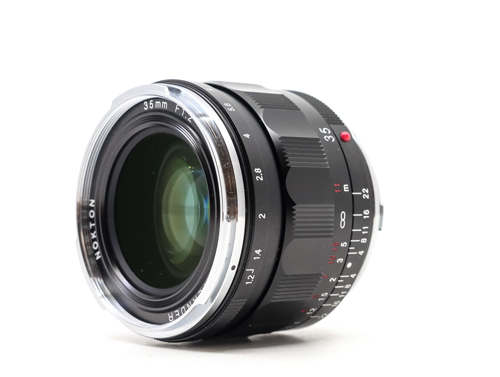
Voigtlander NOKTON 40mm f/1.2 Aspherical VM
Sold by Shop (Asia)
€551 ≈ $595
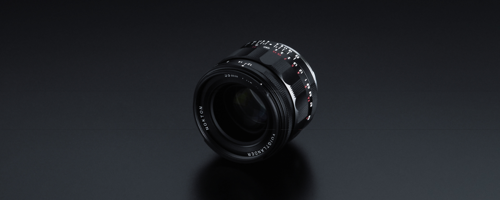
The Voigtländer Nokton 40mm f/1.2 Aspherical is a compact, ultra-fast manual-focus normal-wide prime in Leica M mount, prized for its rendering.
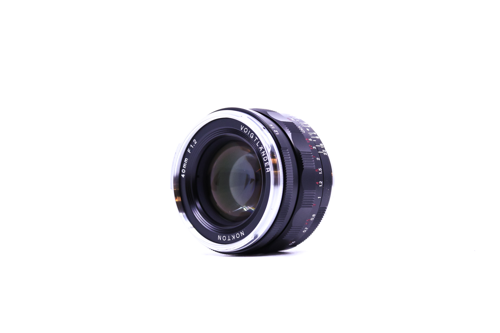
M mount
The Voigtländer Nokton 40mm f/1.2 is a M-mount lens for Leica rangefinder cameras. As of October 2026, it sells from €551 used across 3 listings, with a 30-day median of €698. Leica price index →
Measured against the 9 other 40mm M-mount lenses in the catalogue.
When Cosina introduced an f/1.2 lens at 40mm, it filled an unusual gap in the rangefinder catalogue: a focal length close to the theoretical "normal" of a 35mm frame, paired with a maximum aperture rarely seen at that length. The slightly-wider-than-standard angle of view gives a natural perspective, while the bright aperture pushes the lens toward the subject-isolation territory normally associated with a fast 50mm, the background blur being roughly comparable to a 50mm at around f/1.4 to f/1.5 [1][3]. Built by Cosina under the licensed Voigtländer name, it has been positioned as an affordable yet seriously fast standard prime for Leica M and other mirrorless systems [2].
The optical formula uses eight elements in six groups, with two double-sided aspherical elements (four aspherical surfaces) intended to control aberrations and keep the lens compact despite its speed. The barrel is all metal with a scalloped focus ring and a clicked aperture ring, and reviewers consistently praise the handling as smooth, weighty and free of play. The lens couples to the rangefinder and focuses down to about 0.7 m at the coupling, with closer focusing of roughly 0.5 m available when using live view or an electronic viewfinder, beyond the range of the M coupling arm[4]. On a Leica M the lens brings up the 50mm and 75mm framelines rather than a dedicated 40mm frame, so framing requires accounting for that mismatch.
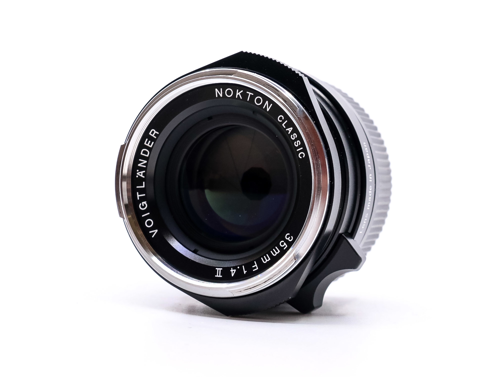
The Nokton 40mm f/1.2 has been produced in several mount versions. The Leica M (VM) version arrived first, followed by dedicated Sony E, Nikon Z and Canon RF designs; the mirrorless versions are optically tuned for their respective sensor stacks, and the E, Z and RF lenses differ in dimensions, filter size, blade count and accessories from the M-mount lens. The native mirrorless versions also add electronic contacts for EXIF data and focus aids, which the M-mount lens lacks. A revised Type II VM version was later released, described by the maker and retailers as lighter, optimized for current Leica sensors, and fitted with a fully blacked-out filter ring to suppress reflections; published figures for the two M-mount generations differ in weight and other details, so buyers should confirm which version a listing refers to.
Rendering The lens has a dual personality. Wide open it is centrally sharp and contrasty but shows a softer, lower-contrast, slightly classic draw, which several reviewers describe as dreamy or characterful, while stopping down to around f/4 and beyond yields crisp, high-contrast results. It is frequently compared to fast classic lenses for the way it combines that character with modern coatings and contrast.
Sharpness Central resolution is strong from f/1.2, better than many older f/1.2 designs, and the image cleans up substantially by f/2; the frame becomes very sharp across most of the field by about f/4 to f/8, though the extreme corners lag at the widest settings.
Bokeh and transitions The out-of-focus rendering is generally smooth and well regarded, with relatively restrained outlining for an aspherical lens. Because of the aspherical surfaces there are some traces of onion-ring texture in specular highlights, and bokeh balls turn to cat's-eye shapes toward the edges wide open, becoming geometric as the diaphragm closes.
Distortion and vignetting Distortion is minimal in practice, while vignetting is heavy at f/1.2 and clears progressively, becoming easy to correct by the middle apertures.
Aberrations Axial chromatic aberration produces visible violet fringing wide open; it improves markedly by f/2 and is largely gone by f/2.8 to f/4. The lens also shows some focus shift and field curvature, so careful focusing, ideally at or near the taking aperture, gives the best results.
Flare resistance Flare is handled well for such a fast lens, with clean sunstars at smaller apertures and generally controlled veiling; what flare appears tends to be soft-edged rather than distracting.
Development and Launch Voigtländer is one of the oldest names in optics, founded in Vienna in 1756 and later central to early photographic lens design; since 1999 the brand has been licensed to the Japanese maker Cosina, which has produced Cosina Voigtländer lenses across Leica M, Sony E, Nikon Z, Fuji X and other mounts. The Nokton 40mm f/1.2 Aspherical was launched in this modern Cosina era, with the Leica M-mount version among the first releases, and was promoted as the fastest 40mm lens offered for the M system.
Production Evolution The design has been adapted across mounts over time, with the original M-mount lens joined by sensor-optimized Sony E, Nikon Z and Canon RF versions, and later by a revised Type II M-mount lens described as lighter and re-optimized for current Leica digital bodies, with a blackened filter ring to reduce reflections. Because published specifications vary between these generations and mounts, the exact figures for weight, filter size and aperture-blade count depend on the specific version.
Special editions No major factory special editions, military or commemorative variants of this lens are widely documented; the notable differences are between mount versions and the first and second VM generations rather than limited runs.
Collector Notes The most important identification points are version and mount. The M-mount lens is purely mechanical and rangefinder-coupled, whereas the Sony E, Nikon Z and Canon RF lenses carry electronic contacts and are not interchangeable. Buyers should confirm whether a listing is the original VM lens or the later Type II, as the two differ in weight and finish details, and should verify that the supplied metal screw-in hood and caps are present, since the dedicated hood affects vignetting and the cap design is specific to the lens. As a current production lens rather than a vintage item, haze and coating decay are not typical concerns, but checking for decentering and smooth, play-free focus is worthwhile on used copies.
Good time to buy. The lowest listing is 21% below the 30-day average.
Lowest price Click a mark to open that listing · arrow keys to step, Enter to open
Price against condition for 3 listings of Voigtländer Nokton 40mm f/1.2, €551 to €1,038, median €698. New: 1 at €1,038. Mint: 1 at €551. Used: 1 at €698. The full table follows.
| Condition | Lowest | Median |
|---|---|---|
| New | €1,038 | €1,038 |
| Mint | €551 | €551 |
| Other | €698 | €698 |
Over the last 18 weeks the median price for the Voigtländer Nokton 40mm f/1.2 has fallen, ranging from €534 to €999 (now €698).
Weekly price (EUR). Median (Good or better) and lowest (Good or better) across 18 weeks. The full figures follow in the table below.
| Week | Median | Lowest |
|---|---|---|
| Jun 1, 2026 | €999 | €999 |
| Jun 8, 2026 | €999 | €999 |
| Jun 15, 2026 | €551 | €551 |
| Jun 22, 2026 | €551 | €551 |
| Jun 29, 2026 | €551 | €551 |
| Jul 6, 2026 | €551 | €551 |
| Jul 13, 2026 | €551 | €551 |
| Jul 20, 2026 | €681 | €551 |
| Jul 27, 2026 | €681 | €551 |
| Aug 3, 2026 | €686 | €551 |
| Aug 10, 2026 | €687 | €551 |
| Aug 17, 2026 | €551 | €551 |
| Aug 24, 2026 | €551 | €551 |
| Aug 31, 2026 | €551 | €551 |
| Sep 7, 2026 | €551 | €551 |
| Sep 14, 2026 | €551 | €551 |
| Sep 21, 2026 | €551 | €551 |
| Sep 28, 2026 | €795 | €551 |
Every shop grades differently. Leica Classic uses letters, Ffordes uses E++ and E+, German dealers write "Zustand B", Japanese dealers write A−. We map all of them onto the one ladder below. Where a shop states its own grade, we print it under ours.
As of October 2026, the Voigtländer Nokton 40mm f/1.2 sells from €551 used, with a 30-day median of €698, across 3 active listings.
As of October 2026, the Voigtländer Nokton 40mm f/1.2 is sold by 2 sources (3 listings), from €551 used: all compared cheapest-first on this page.
Similar lenses you might be interested in
Comments