The TTArtisan 28mm f/5.6 is a brass pancake wide-angle for Leica M mount, a low-cost homage to the 28mm Summaron prized for its tiny size.
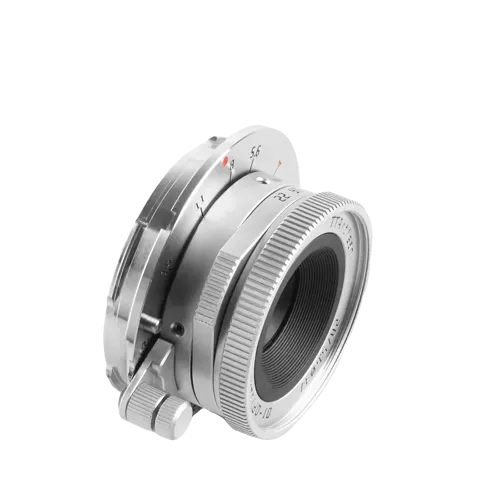
TTArtisan 28mm f/5.6
M mount
No listings tracked for this lens right now.
The TTArtisan 28mm f/5.6 is a M-mount lens for Leica rangefinder cameras. Leica price index →
How it compares
Measured against the 37 other 28mm M-mount lenses in the catalogue.
Specification
About this lens
TTArtisan 28mm f/5.6
Among the wide-angle lenses for Leica M cameras, the TTArtisan 28mm f/5.6 stands out for being a deliberate visual homage to the classic 28mm Summaron, reissued by a Chinese maker at a fraction of the price. Reviewers note that while TTArtisan's earlier optics already borrowed Leica styling, this design copies the overall shape of the Summaron closely, down to a rectangular vintage-style hood, although the optical formula itself is new [1][2]. The appeal is squarely about size: a maximum aperture of f/5.6 is modest, but the trade-off is one of the smallest M-mount lenses available, a true pancake intended for unobtrusive shooting[3].
The optics use seven elements in four groups, with TTArtisan citing high-index and low-dispersion glass, and the diaphragm is built from six inwardly curved blades. The barrel is so compact that focusing relies on a small focus tab rather than a gripable ring, traveling roughly 90 degrees from the 1 m minimum focus distance to infinity, where a spring-loaded infinity lock holds the setting until a button on the tab is pressed. The aperture ring carries full-stop clicks across its short throw from f/5.6 to f/22, and the lens is rangefinder coupled across the full focus range, displaying correct 28mm framelines on a Leica M10 without expected calibration issues. Build quality draws consistent praise: the casing is metal, described by reviewers as essentially all brass with engraved, paint-filled markings, and dense for its size, with one comparison finding it lighter than the Leica original yet feeling at least as robust. There is no depth-of-field scale and no weather sealing. The lens is also widely adapted to mirrorless bodies, where wide M-mount designs typically show weaker corners.
The lens is offered in a silver finish and is a recent product rather than a vintage collectible, so there is little version history to track. One documented user modification, reported in the comments of a published review, is painting exposed bare brass at the rear with matte black paint to reduce internal reflections and improve flare resistance.
Optical qualities
Rendering The 28mm f/5.6 renders with high contrast and good central sharpness for a small wide-angle, with film users reporting punchy, sharp results across the frame and a notably distortion-free image, which is valued for darkroom printing. Given the slow aperture, wide focal length and 1 m close-focus limit, it produces essentially no subject separation, so it is not a lens for shallow depth of field.
Sharpness On a 24-megapixel Leica M10 the lens delivers even, good across-frame performance around f/8 to f/11, with resolution falling off afterward due to diffraction; on a higher-resolution 42-megapixel Sony sensor the center is good from f/5.6 and the midframe from f/8, but the corners never reach strong figures.
Distortion and vignetting Barrel distortion is low and easily corrected, but corner shading is heavy: a reviewer measured about 2.4 EV wide open, improving only slightly to roughly 2.0 EV stopped down to f/11 and f/16. A slight bluish corner color cast was also noted on the Leica M10.
Flare resistance Flare resistance is a weak point. A bright light source just outside the frame can trigger strong veiling flare across much of the image, mitigated by shading the lens or, per a reader's report, by blacking out reflective rear brass.
Aberrations Lateral chromatic aberration is very low, and because the maximum aperture is only f/5.6, longitudinal CA is rarely seen; mild coma in the extreme corners at maximum aperture clears up significantly by f/8. With its six inwardly curved blades the lens produces only weak sunstars and they are difficult to coax out.
History
Development and Launch TTArtisan introduced the 28mm f/5.6 for Leica M mount around late 2021, with early reviews appearing in January 2022. The company, better known at the time for fast lenses such as a 50mm f/0.95 and a 90mm f/1.25, positioned this as something very different: a compact, slow wide-angle modeled on the 28mm Summaron that Leica first released in 1955 and later reissued. It launched at a low price relative to the Leica lens it echoes.
Collector Notes This is a current-production lens rather than a vintage one, so originality and serial-number concerns are minimal. Buyers should be aware of the handling quirks built into the design, namely the infinity lock that must be released before refocusing and the relatively long 1 m minimum focus distance for a 28mm lens, both noted by reviewers as the main practical drawbacks. The original rectangular hood, caps and a 37 mm filter thread are worth confirming as present, since the matching vintage-style hood is part of the lens's appeal and helps with flare control.
Sources
Where to buy
Related lenses
Similar lenses you might be interested in
Comments