Best price
TTArtisan 11mm f2.8 Fisheye with Optical Viewfinder - Leica M
Sold by The Camera Store
€214 ≈ $231
The TTArtisan 11mm f/2.8 is a diagonal fisheye for Leica M mount, notable as the first full-frame fisheye made for the rangefinder system.
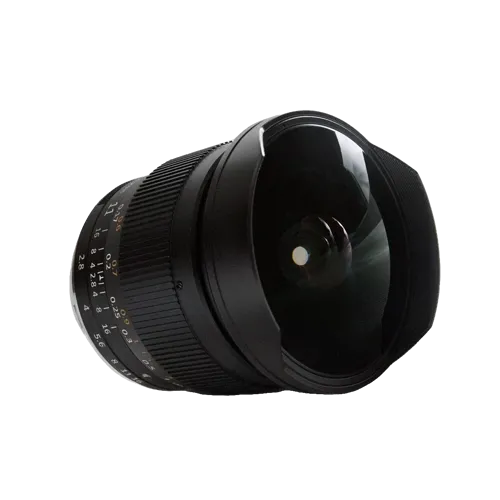
M mount
The TTArtisan 11mm f/2.8 is a M-mount lens for Leica rangefinder cameras. As of October 2026, it sells from €214 used across 1 listing, with a 30-day median of €214. Leica price index →
The TTArtisan 11mm f/2.8 stands out as a rarity in the Leica M catalogue: a diagonal fisheye covering a 180 degree field of view across the diagonal of a full-frame sensor or frame [1]. Fisheye optics have never been common on the rangefinder system, and reviewers noted that in more than sixty years of the Leica M mount no native full-frame fisheye had existed before this lens, which TTArtisan positioned as the first of its kind for both M-mount cameras and full-frame mirrorless bodies by way of adapters[2]. As a diagonal rather than circular fisheye, it fills the whole frame instead of projecting a round image inside it.
The optical formula uses eleven elements in seven groups, with a 7-blade aperture and a minimum focusing distance of about 0.17 m. The barrel is largely metal, and the cosmetic treatment deliberately echoes a Leica M lens, including a red index dot and engraved, paint-filled markings. The focus ring travels roughly 90 degrees from the 0.17 m close limit to infinity, while the aperture ring is a simpler clickless design with uneven spacing between stops and a small grip tab. Given the extreme focal length, depth of field is very deep, so most users rely on the distance scale rather than precise focusing, and at f/2.8 a wide zone from roughly one metre to infinity can already be held in focus. The lens has no front filter thread, and a slip-on metal cap is supplied; review samples also shipped with an 11mm optical viewfinder, which is useful on a rangefinder body that cannot frame this angle of view through its own finder.
Because it is so wide, the practical experience differs from a coupled standard lens, and at least one reviewer worked with it as a scale-focus optic on the rangefinder, relying on depth of field rather than the rangefinder patch. LeicaLensList records the lens as rangefinder coupled; this is the value to follow, though buyers may wish to confirm coupling behaviour on their own camera, as published accounts of focusing practice with this lens vary.
Rendering The lens produces the strong curvilinear projection expected of a diagonal fisheye, bending straight lines that do not pass through the centre of the frame. The look is the deliberate point of the lens rather than a flaw, and defishing software exists but costs significant resolution, so most users keep the fisheye effect. Documented behaviour is otherwise reasonable for an inexpensive ultra-wide.
Sharpness Reviewers found the centre strong from wide open with the midframe close behind, while the extreme corners benefit from stopping down; around f/4 produces an even result across the frame when focused centrally. On Sony mirrorless bodies, a degree of filter-stack-induced field curvature was noted, which is less of an issue on the lens's native rangefinder mount.
Bokeh and transitions The combination of a relatively fast f/2.8 aperture and the very short 0.17 m focusing distance allows some background blur if the subject is brought extremely close, and the out-of-focus rendering was described as surprisingly clean with only minor outlining.
Flare resistance With the sun near the centre of the frame, flare is well controlled; with a bright light source toward the corner or just outside the frame, internal reflections and some ghosting appear wide open and diminish on stopping down.
Distortion and vignetting Heavy barrel distortion is inherent to the fisheye projection and is by design. Vignetting is comparatively mild for such a wide lens, lower than many compact rectilinear ultra-wides, though a slight green colour cast can appear in the corners against bright skies.
Aberrations Lateral chromatic aberration is visible at the extreme corners, in line with other fisheye lenses, but it corrects well in software and is rarely objectionable in practice.
Development and Launch TTArtisan, a Shenzhen-based maker of affordable manual-focus lenses, introduced the 11mm f/2.8 as an inexpensive way to obtain a full-frame fisheye, with reviews appearing from late 2019 onward. Its significance comes from filling a long-standing gap: no other manufacturer had offered a native full-frame fisheye for the Leica M mount, and the lens was also promoted as the first full-frame fisheye designed with mirrorless cameras in mind, usable on Sony, Nikon and other systems through M-mount adapters.
Special editions No major factory special editions or variant finishes of this lens are widely documented. It is generally listed in a black finish, and TTArtisan has offered the same optic in several lens-mount versions for mirrorless cameras alongside the M-mount version.
Collector Notes Buyers should verify that the slip-on metal cap and, where relevant, the matching 11mm optical viewfinder are included, since the finder is the practical way to frame this angle of view on a rangefinder and may have been an optional accessory. The lens has no filter thread, so screw-in filters are not an option. One reviewer observed apparent decentering on a sample, with one side of the frame softer than the other, so checking corner-to-corner evenness on a test frame is worthwhile before purchase. Note also that published descriptions of whether the lens is rangefinder coupled differ from the value recorded here; LeicaLensList lists it as coupled, and that figure takes precedence.
About the usual price. The lowest listing is around the 30-day average.
Over the last 14 weeks the median price for the TTArtisan 11mm f/2.8 has fallen, ranging from €214 to €222 (now €214).
Weekly price (EUR). Median (Good or better) and lowest (Good or better) across 14 weeks. The full figures follow in the table below.
| Week | Median | Lowest |
|---|---|---|
| Jul 6, 2026 | €215 | Unknown |
| Jul 13, 2026 | €215 | Unknown |
| Jul 20, 2026 | €215 | Unknown |
| Jul 27, 2026 | €216 | Unknown |
| Aug 3, 2026 | €217 | Unknown |
| Aug 10, 2026 | €220 | Unknown |
| Aug 17, 2026 | €222 | Unknown |
| Aug 24, 2026 | €220 | Unknown |
| Aug 31, 2026 | €221 | Unknown |
| Sep 7, 2026 | €220 | Unknown |
| Sep 14, 2026 | €217 | Unknown |
| Sep 21, 2026 | €215 | Unknown |
| Sep 28, 2026 | €214 | Unknown |
| Oct 5, 2026 | €214 | Unknown |
Every shop grades differently. Leica Classic uses letters, Ffordes uses E++ and E+, German dealers write "Zustand B", Japanese dealers write A−. We map all of them onto the one ladder below. Where a shop states its own grade, we print it under ours.
As of October 2026, the TTArtisan 11mm f/2.8 sells from €214 used, with a 30-day median of €214, across 1 active listing.
As of October 2026, the TTArtisan 11mm f/2.8 is sold by 1 source (1 listing), from €214 used: all compared cheapest-first on this page.
Similar lenses you might be interested in

Comments