Best price Excellent
TTArtisan TT Artisan 100mm f2.8 DJ Optical 810101283
Sold by Camera West
€139 ≈ $150
The TTArtisan 100mm f/2.8 is a modern soap-bubble-bokeh triplet in Leica M mount, a low-cost Trioplan homage that draws collector interest for its character.
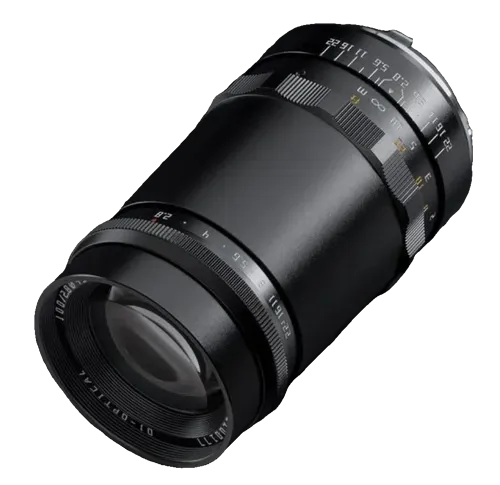
M mount
The TTArtisan 100mm f/2.8 is a M-mount lens for Leica rangefinder cameras. As of October 2026, it sells from €139 used across 2 listings, with a 30-day median of €167. Leica price index →
The TTArtisan 100mm f/2.8 exists primarily to recreate one optical trait: the so-called soap bubble bokeh associated with the vintage Meyer-Optik Görlitz Trioplan 100mm. It is a deliberately simple three-element, three-group design, a Cooke-type triplet of the kind Meyer-Optik used for its Trioplan line, and TTArtisan introduced it in 2023 as a low-cost modern interpretation of that lens in both look and optical layout [1]. The original Trioplan 100mm was produced from the mid-1950s into the late 1970s or early 1980s, fell out of favour because Pentacon offered better 100mm lenses, then gained a cult following in the digital era for its bubble bokeh, prompting a revived Kickstarter version that sold around €1000; TTArtisan's homage covers similar ground at a fraction of the price.
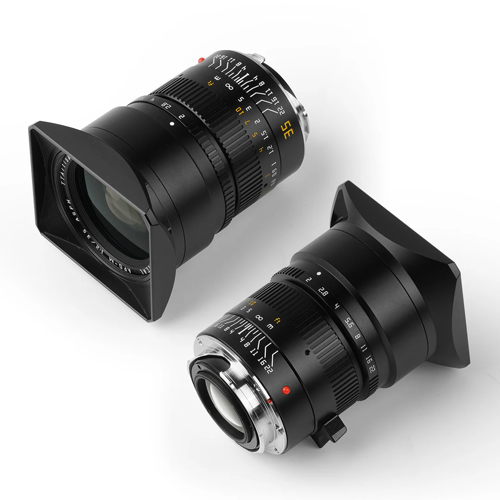
The lens is fully manual, with no electronic contacts, focus confirmation, or EXIF transmission. It is built entirely of metal with engraved, paint-filled scales for aperture, distance in metres and feet, and depth of field, and it ships with screw-on metal caps in keeping with its retro styling[2]. The 13-bladed diaphragm keeps the aperture rounded, and the aperture ring uses click stops whose spacing narrows as the lens is stopped down, with full-stop clicks between f/2.8 and f/11 and no intermediate clicks from f/11 to f/22. Focusing extends the barrel, and the minimum focus distance is 0.9 m. In the M-mount form the lens is rangefinder coupled, so it can be focused through a Leica M coupled rangefinder rather than only by live view or focus peaking.
The lens is offered in two mounts, a Leica M version and an M42 screw version, with the M42 model sold with a chosen mount adapter to keep costs down. Because the M42 version uses an adapter to reach a mirrorless flange, that version can be focused closer than the listed minimum, whereas the rangefinder-coupled M-mount version behaves as a fixed native-mount lens. One early user of the M-mount copy reported strong vignetting at all apertures that was not seen on the M42 sample, a single anecdotal report rather than an established pattern.
Rendering This is a character lens rather than a corrected one, and its appeal rests on the bubble bokeh. Reviewers describe it as capable of producing some of the most distinct soap-bubble highlights they have seen when the background and lighting suit it, while also rendering soft, pleasant conventional blur when stopped down slightly. Because vignetting is not pronounced, out-of-focus highlights stay fairly round across the frame rather than being clipped toward the edges.
Sharpness Wide open the centre is only acceptable and contrast is low, with the mid-frame weaker and the corners poor; stopping down improves things progressively, with the centre and mid-frame reaching good levels by f/8 and the corners becoming acceptable only around f/11. A second reviewer likewise found f/2.8 very soft and critical focus hard to confirm, treating sharpness as secondary to the lens's character.
Contrast and color Contrast is low straight out of camera, particularly wide open, and is often lifted in post-processing.
Flare resistance Flare resistance is a clear weakness; one reviewer described flaring as among the worst seen, with an off-frame light source able to wash out the image.
Distortion and vignetting Vignetting is reported as low on the tested sample, which helps preserve the shape of the bokeh balls across the frame.
Development and Launch The lens descends conceptually from the Cooke triplet of 1893 and from Meyer-Optik Görlitz's postwar Trioplan series, whose 100mm f/2.8 became sought after for its bubble bokeh once digital photographers rediscovered the effect. TTArtisan released its version in 2023, presenting a new triplet that mirrors the Trioplan's appearance and simple optical formula at a much lower price.
Special editions No major factory special editions of this lens are widely documented. The principal variation is one of mount: a Leica M version and an M42 screw version, the latter supplied with an adapter for the buyer's chosen system.
Collector Notes The TTArtisan name on this 100mm f/2.8 can be confused with TTArtisan's unrelated 100mm f/2.8 Macro 2X and its tilt-shift variant, which are larger multi-element macro lenses with different filter threads and no rangefinder coupling. The lens of interest here is the simple triplet bubble-bokeh model. Buyers wanting rangefinder use should confirm the Leica M version rather than the M42 version, since only the M version is rangefinder coupled. One published weight figure of about 318 g refers to the M42 version measured with its metal cap and differs from the heavier value recorded for the M-mount lens, so confirm which mount and configuration a listing describes.
Good time to buy. The lowest listing is 17% below the 30-day average.
Lowest price Click a mark to open that listing · arrow keys to step, Enter to open
Price against condition for 2 listings of TTArtisan 100mm f/2.8, €139 to €194, median €167. New: 1 at €194. Excellent: 1 at €139. The full table follows.
| Condition | Lowest | Median |
|---|---|---|
| New | €194 | €194 |
| Excellent | €139 | €139 |
Over the last 19 weeks the median price for the TTArtisan 100mm f/2.8 has fallen, ranging from €116 to €202 (now €167).
Weekly price (EUR). Median (Good or better) and lowest (Good or better) across 19 weeks. The full figures follow in the table below.
| Week | Median | Lowest |
|---|---|---|
| Jun 1, 2026 | €202 | Unknown |
| Jun 8, 2026 | €202 | Unknown |
| Jun 15, 2026 | €202 | Unknown |
| Jun 22, 2026 | €202 | Unknown |
| Jun 29, 2026 | €202 | Unknown |
| Jul 6, 2026 | €116 | €116 |
| Jul 13, 2026 | €116 | €116 |
| Jul 20, 2026 | €116 | €116 |
| Jul 27, 2026 | €116 | €116 |
| Aug 3, 2026 | €116 | €116 |
| Aug 10, 2026 | €116 | €116 |
| Aug 17, 2026 | €159 | €116 |
| Aug 24, 2026 | €139 | €116 |
| Aug 31, 2026 | €139 | €116 |
| Sep 7, 2026 | €139 | €116 |
| Sep 14, 2026 | €139 | €116 |
| Sep 21, 2026 | €139 | €116 |
| Sep 28, 2026 | €167 | €139 |
| Oct 5, 2026 | €167 | €139 |
Every shop grades differently. Leica Classic uses letters, Ffordes uses E++ and E+, German dealers write "Zustand B", Japanese dealers write A−. We map all of them onto the one ladder below. Where a shop states its own grade, we print it under ours.
As of October 2026, the TTArtisan 100mm f/2.8 sells from €139 used, with a 30-day median of €167, across 2 active listings.
As of October 2026, the TTArtisan 100mm f/2.8 is sold by 1 source (2 listings), from €139 used: all compared cheapest-first on this page.
Similar lenses you might be interested in
Comments