Best price Fair
SANKYO KOHKI KOMURA 80mm f/3.5 L39 LTM Leica Thread Mount Lens from Japan
Sold by Five Star Camera
€288 ≈ $311
The Sankyo-Kohki Komura 80mm f/3.5 is a short telephoto in Leica screw mount (LTM), a rangefinder-coupled Japanese lens of niche interest to collectors.</parameter> <parameter name="long_description">## Sankyo-Kohki Komura 80mm f/3.5 The Komura 80mm f/3.5 belongs to a family of affordable Japanese lenses that competed with established German and domestic makers by offering interchangeable-mount optics at lower prices. It was made by Sankyo Kohki Co., Ltd., the Tokyo optical firm that built lenses under the Komura brand for a wide range of cameras, including Leica screw-mount rangefinders [1][2]. Documentation specific to the 80mm f/3.5 is sparse, so much of what can be said about it is best understood through the wider Komura rangefinder line and the company's general design practices rather than through dedicated reviews of this focal length. As a Leica thread-mount (LTM, M39) lens, this 80mm couples to a rangefinder for focusing and reaches a close focus of 1.25 m. Its short-telephoto length sits a little beyond the more common 75mm and 90mm portrait options, and a maximum aperture of f/3.5 marks it as a modest-speed design rather than a fast portrait lens. The diaphragm uses ten blades, which tends to keep the aperture opening reasonably round through the stops. Sankyo Kohki was known for selling fast or unusually specified lenses in Leica screw mount as a way to carve out a market niche against larger rivals [3][4]. The firm also produced Komura optics for Nikon rangefinders and, through adapter systems, for numerous SLR mounts, so a buyer should confirm that a given example is the rangefinder-coupled LTM version rather than a converted or adapted barrel. Recorded variants of this exact lens are not well documented in the sources consulted. The lens was offered in black and silver finishes. Komura branding generally appears as "Sankyo Kohki" on lens badges, while English-language trademark filings used the spelling "Sankyo Koki," a point that can cause confusion when searching records and listings. --- ## Optical qualities **Rendering** Detailed, lens-specific test data for the Komura 80mm f/3.5 is not available in the sources reviewed, so firm performance claims cannot be made for this particular model. More broadly, knowledgeable collectors have praised Komura lenses for high contrast, pleasing color rendering, and smooth bokeh. Those traits describe the brand's reputation in general and should be treated as context rather than as measured results for this specific 80mm. --- ## History **Development and Launch** Sankyo Kohki traces to an optical research institute established in 1951 and was reorganized as Sankyo Kohki Co., Ltd. in 1955; the Komura brand name was first used in 1953 and was formed from the names of company principals. By around 1960 the firm had become one of the largest third-party lens makers in Japan, with wide-angle and medium-telephoto lenses that were popular for offering good image quality below the price of more established brands, which drew interest from Western photographers and American distributors. **Production Evolution** Komura's interchangeable lenses are frequently noted for preset-style aperture construction, with the optical system and aperture in a front section and a helicoid in the rear section that could be separated and swapped by hand. Over the 1960s and 1970s the company expanded into Bronica medium-format lenses, the Komura Unidapter adapter system for many SLR mounts, and later the Komuranon SLR series, before changing its name to Komura Lens Manufacturing, Ltd. and becoming insolvent in 1980. **Special editions** No major factory special editions of the 80mm f/3.5 are widely documented in the sources reviewed. **Collector Notes** Buyers should confirm the lens is the rangefinder-coupled Leica screw-mount version, since Komura optics were sold for several systems and were sometimes adapted between mounts. Brand-wide, collectors note that the rear element of some Komura preset designs is prone to fogging and scratches, which makes clean examples scarcer; inspecting the rear glass for haze and coating wear is therefore worthwhile, even though that observation comes from the broader Komura line rather than this specific lens. Because the maker's name appears as both "Sankyo Kohki" and "Sankyo Koki," searching under both spellings helps when verifying a purchase. --- ## Sources * [1] Kameramanufaktur. *Sankyo Kohki and the Komura lenses*. https://kameramanufaktur.jimdofree.com/lenses/komura-lenses/ * [2] FilmPhotograph.com. *About Komura*. https://filmphotograph.com/komura/about * [3] Mike Eckman. *Sankyo Kohki Komura 500mm f/7*. https://mikeeckman.com/2022/10/sankyo-kohki-komura-500mm-f-7/ * [4] Rangefinderforum (Jason Schneider). *Komura Lenses For Bronicas: Better Than Their Rep & Still Relatively Cheap*. https://rangefinderforum.com/threads/komura-lenses-for-bronicas-better-than-their-rep-still-relatively-cheap.4761676/
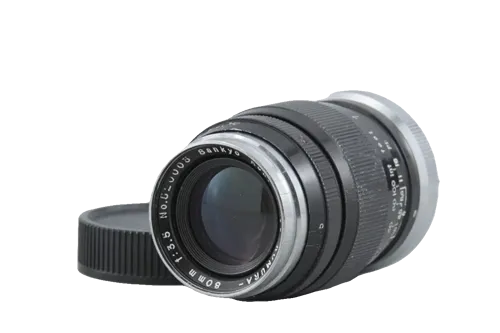
LTM mount
The Sankyo-Kohki Komura 80mm f/3.5 is a LTM-mount lens for Leica rangefinder cameras. As of October 2026, it sells from €288 used across 1 listing, with a 30-day median of €288. Leica price index →
Measured against the 4 other 80mm LTM-mount lenses in the catalogue.
The Komura 80mm f/3.5 sits at the slower, more compact end of Sankyo Kohki's short telephoto offerings for Leica screw mount, where it lived alongside the better known and much faster Komura 80mm f/1.8. As a rangefinder-coupled lens in Leica thread mount (LTM, also called L39 or M39), it focuses through the camera's coupled rangefinder and fits the broad family of Leica and Leica-compatible screw bodies, as well as the many Japanese and European rangefinders sharing that standard. Sankyo Kohki built lenses under the Komura name from the early 1950s onward, and by 1960 the firm had grown into one of the largest independent lens makers in Japan, supplying optics across a wide range of mounts and focal lengths [1].
The lens is a conventional moderate-aperture short telephoto. Its ten-bladed diaphragm produces a rounded aperture opening, and the relatively modest f/3.5 maximum speed keeps the optical assembly compact and light compared with the f/1.8 sibling. Close focus is about 1.25 m, in line with other rangefinder portrait-length lenses of the era, and the coupling to the camera rangefinder allows accurate focusing at typical portrait distances. Like other Komura LTM lenses, it was offered in black-and-chrome finish.
Documented detail specific to this slower 80mm is limited. Sankyo Kohki produced a very large catalogue of interchangeable lenses for rangefinder, SLR, and other mounts, and Komura-branded screw-mount lenses for Leica and for the Nikon rangefinder system were among the company's most common products. The 80mm f/3.5 is far scarcer in the secondhand market than the faster 80mm f/1.8, and surviving examples are mostly identified by the maker's marking on the front beauty ring rather than by published model numbers.
Rendering There is little detailed, independent test data for the 80mm f/3.5 specifically, so its rendering is best described in general terms. As a single-focal-length, moderate-aperture short telephoto from a respected mid-century Japanese third-party maker, it is the type of lens that gave Sankyo Kohki its reputation: medium telephoto and wide-angle Komura optics were valued for offering good image quality at prices below the established German and Japanese brands. Beyond that, claims about its sharpness, contrast, bokeh, flare, or distortion are not supported by reliable published sources and are best verified on a given example, since coating wear and haze are common on lenses of this age.
Development and Launch Komura was the brand name for lenses made in Japan by Sankyo Kohki beginning in the early 1950s. Little is recorded about the company's origins, but as Japan's optical industry expanded after the war, many independent lens makers emerged, and Sankyo Kohki's earliest products were sold under the Chibanon (also spelled Chivanon) name, including lenses for enlargers and early Japanese folding cameras. As the company grew, its range expanded to interchangeable lenses for rangefinders and SLRs, with Leica thread mount and Nikon rangefinder mount lenses being the most common.
Production Evolution By 1960 Sankyo Kohki was one of the largest independent lens manufacturers in Japan, and the popularity of its wide-angle and medium telephoto lenses drew the attention of Western photographers and American distributors such as Joseph Ehrenreich, leading to a US trademark filing in December 1962. The clearest single snapshot of the company's lineup comes from a 1965 Komura dealer catalogue published by EPOI International, Ltd, a subsidiary of Ehrenreich Photo Optical Industries Inc of New York, which showed about 40 lenses from 28mm to 800mm covering most rangefinder, SLR, and C-mount cameras. The short 80mm telephoto class fell within this rangefinder-oriented part of the catalogue.
Collector Notes The 80mm f/3.5 is easily confused with the much more sought-after Komura 80mm f/1.8, which appears far more often in listings and references; buyers should confirm the marked maximum aperture rather than rely on the 80mm focal length alone. As with most lenses of this vintage and origin, examples frequently show haze, faint internal fungus, coating wear on the front element, and stiff or oily helicoids, all of which are worth checking before purchase. Because published documentation for this specific slower variant is thin, originality and mount details are best confirmed visually against the maker's markings on the lens itself.
About the usual price. The lowest listing is around the 30-day average.
Over the last 18 weeks the median price for the Sankyo-Kohki Komura 80mm f/3.5 has fallen, ranging from €288 to €345 (now €288).
Weekly price (EUR). Median (Good or better) and lowest (Good or better) across 18 weeks. The full figures follow in the table below.
| Week | Median | Lowest |
|---|---|---|
| Jun 1, 2026 | €345 | Unknown |
| Jun 8, 2026 | €345 | Unknown |
| Jun 15, 2026 | €345 | Unknown |
| Jun 22, 2026 | €345 | Unknown |
| Jun 29, 2026 | €345 | Unknown |
| Jul 6, 2026 | €345 | Unknown |
| Jul 13, 2026 | €345 | Unknown |
| Jul 20, 2026 | €345 | Unknown |
| Jul 27, 2026 | €345 | Unknown |
| Aug 3, 2026 | €345 | Unknown |
| Aug 10, 2026 | €345 | Unknown |
| Aug 17, 2026 | €345 | Unknown |
| Aug 24, 2026 | €345 | Unknown |
| Aug 31, 2026 | €345 | Unknown |
| Sep 7, 2026 | €310 | Unknown |
| Sep 14, 2026 | €310 | Unknown |
| Sep 21, 2026 | €310 | Unknown |
| Sep 28, 2026 | €288 | Unknown |
Every shop grades differently. Leica Classic uses letters, Ffordes uses E++ and E+, German dealers write "Zustand B", Japanese dealers write A−. We map all of them onto the one ladder below. Where a shop states its own grade, we print it under ours.
As of October 2026, the Sankyo-Kohki Komura 80mm f/3.5 sells from €288 used, with a 30-day median of €288, across 1 active listing.
As of October 2026, the Sankyo-Kohki Komura 80mm f/3.5 is sold by 1 source (1 listing), from €288 used: all compared cheapest-first on this page.
Similar lenses you might be interested in
Comments