The Rollei HFT Planar 80mm f/2.8 is a short telephoto LTM screw-mount rangefinder lens in silver, a scarce HFT-coated entry sought by collectors.
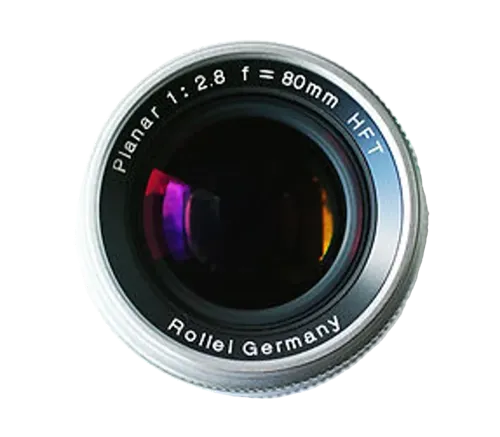
Rollei HFT Planar 80mm f/2.8
LTM mount
No listings tracked for this lens right now.
The Rollei HFT Planar 80mm f/2.8 is a LTM-mount lens for Leica rangefinder cameras. Leica price index →
How it compares
Measured against the 4 other 80mm LTM-mount lenses in the catalogue.
Specification
About this lens
Rollei HFT Planar 80mm f/2.8
The Rollei HFT Planar 80mm f/2.8 is an unusual entry among Leica-thread rangefinder optics: a short telephoto carrying the Planar name and Rollei's HFT (High Fidelity Transfer) multicoating, supplied in a Leica Thread Mount (M39) screw fitting. With an 80mm focal length and an f/2.8 maximum aperture, it sits in the classic portrait-to-short-tele range rather than the more common 50mm or 90mm rangefinder slots, which is part of why it draws collector interest.
Optically the lens uses a compact five-element, four-group arrangement and a maximum aperture of f/2.8, with a ten-blade diaphragm that gives a near-circular opening through the aperture range. It is a rangefinder-coupled design, so focus is read through the camera's coupled rangefinder rather than by ground-glass focusing, with a minimum focus distance of 1.2 m. The barrel is finished in silver, measures about 73 mm in length and 55 mm in diameter, accepts 43 mm filters, and weighs roughly 475 g, making it a dense, all-metal short tele for an M39 body. Mounted via the LTM screw thread, it can be adapted to Leica M bayonet cameras with a standard thread-to-bayonet adapter; the lens itself is not six-bit coded.
Documentation specific to this exact configuration is limited in the collector literature, so version, finish, and serial-number variation cannot be detailed reliably here. Buyers should treat identification and provenance details as items to confirm directly with the seller.
Optical qualities
Rendering Reliable published reviews of this specific lens are scarce, so its rendering character is not well documented. What can be said follows from the design itself: an 80mm Planar-type at f/2.8 is a moderately fast short telephoto suited to portraiture and similar work, the HFT multicoating is intended to improve light transmission and suppress flare and internal reflections, and the ten-blade diaphragm is intended to keep out-of-focus highlights and the aperture opening close to circular when stopped down. Beyond these design-based observations, specific claims about sharpness, contrast, bokeh, distortion, or vignetting are not supported by sources that could be verified, and are therefore omitted.
Sources
- No external source pages could be opened and verified during the preparation of this entry, so no third-party references are cited. The descriptive content above is limited to information that can be stated directly from the lens's known configuration.
Where to buy
Related lenses
Similar lenses you might be interested in
Comments