Best price
MINOLTA (ミノルタ) M-ROKKOR 90/4 CLE (LEICA M)
Sold by Nisshin Camera
€174 ≈ $188
The Minolta M-Rokkor 90mm f/4 is a compact Leica M-mount telephoto built around the CL and CLE rangefinders, prized by collectors for its small size.
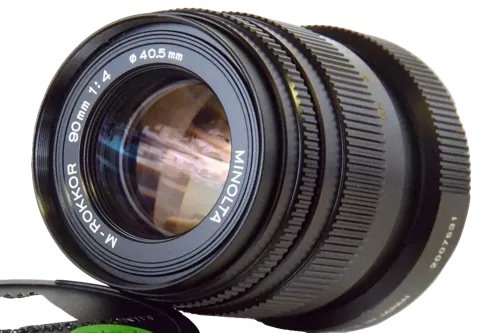
M mount
The Minolta M-Rokkor 90mm f/4 is a M-mount lens for Leica rangefinder cameras. As of October 2026, it sells from €174 used across 3 listings, with a 30-day median of €314. Leica price index →
Measured against the 25 other 90mm M-mount lenses in the catalogue.
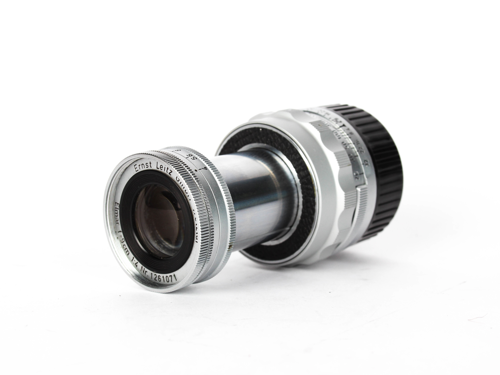
Among the few M-mount lenses ever built outside Wetzlar, the Minolta M-Rokkor 90mm f/4 stands out as the longest of the trio Minolta produced for its compact rangefinder system [1]. It is closely related to the Leitz Elmar-C 90mm f/4, a lens widely described as optically equivalent, the two sharing the same modest f/4 telephoto design even as collectors continue to debate whether coatings changed across the production run [2][3]. The roots of the lens lie in the technical cooperation agreement Leica and Minolta signed in 1972, which led first to the jointly developed Leica CL of 1973 and then to Minolta's own CLE body.
Optically the lens uses a simple four-element, four-group telephoto formula and focuses to one metre, a fairly long minimum focus distance typical of rangefinder optics of the period. The barrel is metal with engraved, paint-filled markings, and handling matches the feel of a Leitz lens of the era: a focus ring that turns roughly 120 degrees from one metre to infinity and an aperture ring with half-stop clicks running from f/4 to f/22 over about 90 degrees, controlling a ten-blade diaphragm. At 61 mm long and 51 mm in diameter it is unusually small for its focal length, a trait reviewers and users repeatedly cite as its main appeal, since it stands upright in a small bag and couples to the rangefinder without needing a focus magnifier. A small retractable screw-in rubber hood was made for it.
Two broad versions are generally recognised: an earlier example tied to the CL era and a later one associated with the CLE that is often said to carry improved multi-coating, with the serial number engraved on the barrel near the "lens made in Japan" marking rather than on the front name ring. Beyond that, version history is poorly documented and contested, and there is no firm consensus on meaningful image-quality differences between early and late examples. Published figures for the filter thread vary, with several sources listing 40.5 mm, though the size most commonly used by collectors is the small thread shared with the other M-Rokkor lenses.
Rendering The lens renders with a restrained, slightly vintage character rather than high modern contrast, and at f/4 it is reported to be crisp across most of the frame, with the centre improving only marginally on stopping down. Some reviewers describe a gentle glow in the highlights and a muted colour palette wide open.
Sharpness Centre sharpness is strong from f/4, the mid-frame benefits from stopping down to f/5.6, and the extreme corners show some field curvature that is best addressed around f/8.
Bokeh and transitions With a maximum aperture of only f/4, shallow depth of field is not the lens's main purpose, and background blur is limited unless the subject is near the minimum focus distance or a close-focus adapter is used.
Flare resistance Flare control is described as mixed: ghosting can appear occasionally and stray light can reduce contrast and saturation, although this is considered respectable for a design of its age, and the hood helps.
Distortion and vignetting The lens shows slight pincushion distortion, mostly toward the corners and rarely visible in practice, while vignetting is roughly 1.8 EV wide open and falls to negligible levels by f/8.
Aberrations Lateral chromatic aberration is on the higher side but correctable in software, and some longitudinal colour fringing is visible in demanding backlit scenes; mild coma appears in the corners at f/4 and f/5.6.
Development and Launch The lens belongs to the compact rangefinder program that grew out of the 1972 Leica-Minolta cooperation. After the Leica CL appeared in 1973, Minolta introduced the CLE in 1981, a TTL-metering, aperture-priority automatic rangefinder taking Leica M lenses, with finder frames for 28, 40 and 90 mm focal lengths. The 90mm f/4 was the telephoto member of the three lenses Minolta made specifically for this system, alongside the 28mm f/2.8 and 40mm f/2.
Production Evolution The most frequently cited change concerns coatings and origin of manufacture, with later examples associated with the CLE often described as multi-coated and marked as made in Japan, identifiable by the placement of the serial number on the barrel rather than the front ring. Documentation of these changes is thin and partly anecdotal, and collectors note a lack of agreement about whether the optics themselves were altered.
Collector Notes The lens is valued chiefly for its compactness and its relationship to the Elmar-C, and good examples can sometimes be found inexpensively. Buyers should verify the originality of the small retractable rubber hood, since the rubber tends to perish at the folds and is frequently replaced. While the 28mm M-Rokkor of the same family is notorious for coating deterioration that leaves white spots, the 90mm is not singled out for that fault, but checking the glass for haze and coating condition remains advisable. Because sources disagree on small details such as the filter thread, comparing an individual lens against the specifications before purchase is sensible.
Good time to buy. The lowest listing is 45% below the 30-day average.
Lowest price Click a mark to open that listing · arrow keys to step, Enter to open
Price against condition for 3 listings of Minolta M-Rokkor 90mm f/4, €174 to €405, median €314. Good: 1 at €314. Unknown: 2 at €174, €405. The full table follows.
| Condition | Lowest | Median |
|---|---|---|
| Good | €314 | €314 |
| Other | €174 | €290 |
Over the last 18 weeks the median price for the Minolta M-Rokkor 90mm f/4 has risen, ranging from €245 to €363 (now €314).
Weekly price (EUR). Median (Good or better) and lowest (Good or better) across 18 weeks. The full figures follow in the table below.
| Week | Median | Lowest |
|---|---|---|
| Jun 1, 2026 | €307 | €299 |
| Jun 8, 2026 | €315 | €299 |
| Jun 15, 2026 | €315 | €299 |
| Jun 22, 2026 | €315 | €299 |
| Jun 29, 2026 | €296 | €293 |
| Jul 6, 2026 | €313 | €309 |
| Jul 13, 2026 | €312 | €309 |
| Jul 20, 2026 | €311 | €307 |
| Jul 27, 2026 | €315 | €315 |
| Aug 3, 2026 | €287 | €287 |
| Aug 10, 2026 | €316 | €312 |
| Aug 17, 2026 | €319 | €315 |
| Aug 24, 2026 | €318 | €313 |
| Aug 31, 2026 | €322 | €322 |
| Sep 7, 2026 | €321 | €321 |
| Sep 14, 2026 | €317 | €317 |
| Sep 21, 2026 | €316 | €316 |
| Sep 28, 2026 | €314 | €314 |
Every shop grades differently. Leica Classic uses letters, Ffordes uses E++ and E+, German dealers write "Zustand B", Japanese dealers write A−. We map all of them onto the one ladder below. Where a shop states its own grade, we print it under ours.
As of October 2026, the Minolta M-Rokkor 90mm f/4 sells from €174 used, with a 30-day median of €314, across 3 active listings.
As of October 2026, the Minolta M-Rokkor 90mm f/4 is sold by 1 source (3 listings), from €174 used: all compared cheapest-first on this page.
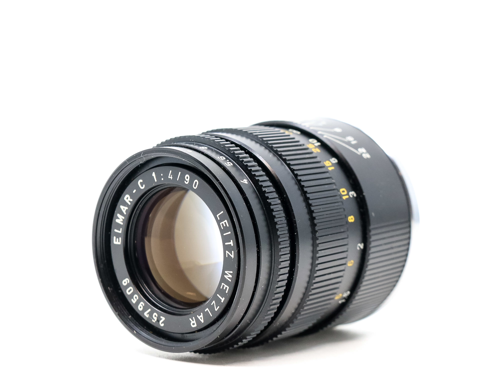
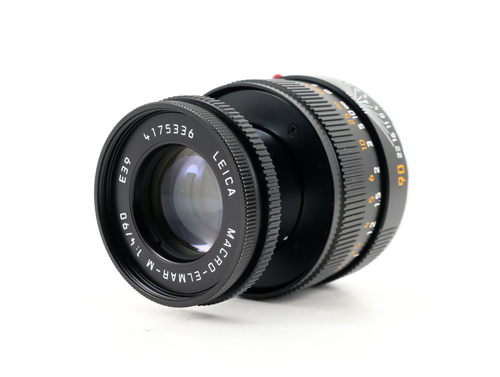
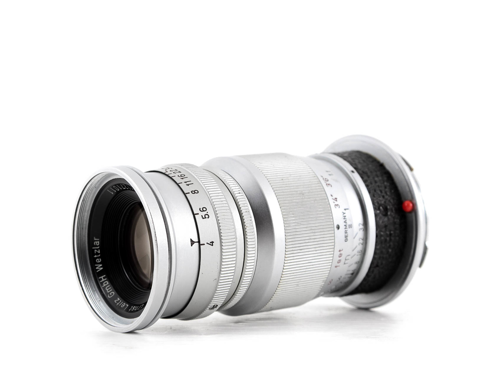
Similar lenses you might be interested in
Comments