The Schneider-Kreuznach Componon-S 50mm f/2.8 is a six-element enlarging lens listed in Leica M mount, prized by macro shooters for high-magnification sharpness.
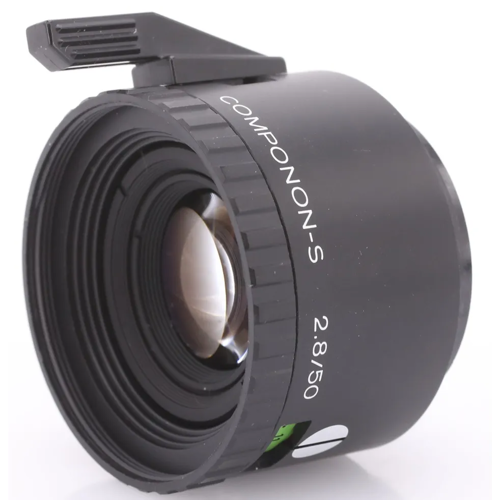
Schneider-Kreuznach Componon-S 50mm f/2.8
M mount
No listings tracked for this lens right now.
The Schneider-Kreuznach Componon-S 50mm f/2.8 is a M-mount lens for Leica rangefinder cameras. Leica price index →
How it compares
Measured against the 73 other 50mm M-mount lenses in the catalogue.
Specification
About this lens
Schneider-Kreuznach Componon-S 50mm f/2.8
The Componon-S 50mm f/2.8 is not a conventional taking lens but one of the best regarded enlarging lenses ever made, a flat-field optic that collectors and macro photographers adapt onto camera bodies for close-up work. Schneider-Kreuznach designed it for printing 35mm negatives in the darkroom, and it is built around a six-element, four-group formula corrected for a flat field, high contrast, and even definition across the frame [1][4]. Because it was never a rangefinder lens in the traditional sense, the Leica M mount recorded for it here reflects how the optic is fitted and used rather than any native bayonet, and it carries no rangefinder coupling and no six-bit coding.
In its original form the lens uses a screw thread rather than a camera bayonet, with a 39mm M39 (Leica thread) rear mount that lets it sit on enlarger lens boards and, with adapters, on bellows and extension systems[3]. The aperture runs on five blades and is operated through a click-stopped scale, with a preset ring so the iris can be opened for focusing and then returned to the working value[5]. The lens has no focusing helicoid of its own and instead relies on a bellows or extension tubes to set magnification and focus; reviewers note it performs best when reversed at magnifications above life size [2]. Reported filter threads vary slightly between sources, with the front accepting small step rings in the low-40mm range.
Several barrel variants exist while the optics stay essentially constant. Collectors describe an older chrome-barrelled version, an all-black metal version, a more recent plastic (BV-L) barrel with a green stripe that is the most common, and an all-metal Makro-Iris industrial body; a fixed, non-variable aperture variant is generally considered less desirable. These differences are cosmetic and mechanical rather than optical, so image quality is broadly the same across them.
Optical qualities
Rendering The Componon-S 50mm f/2.8 is a high-resolution, flat-field optic optimized for reproduction work rather than pictorial rendering. Independent testing for high-magnification macro use found it to be among the sharpest 50mm enlarging lenses available, with very good resolution and sharpness from roughly 1:1 to 4:1 magnification.
Sharpness Center sharpness is strong, peaking around f/4.7, which is also the most resolving aperture in testing. Corner sharpness is the main weakness: it is only adequate at the optimum aperture, especially below life-size magnification, and improves noticeably when stopped down to about f/5.6 or f/6.7 at a small cost in overall resolution.
Contrast and color Image contrast is good, and chromatic aberration is well controlled, with minimal fringing in the center and only minimal to moderate fringing toward the edges at lower magnifications.
Flare resistance Testing showed no significant flare, consistent with collector reports that flare is not an issue with this lens.
Distortion and vignetting As befits a lens corrected for flat-field reproduction, no significant distortion was observed in testing.
Digital use On digital bodies the lens is used as a bellows or extension macro optic, where it is praised for sharpness and useful working distance; the five-blade iris gives a less rounded aperture shape than some users prefer.
History
Development and Launch The Componon-S line is Schneider-Kreuznach's family of high-performance enlarging lenses, and the 50mm f/2.8 is the standard member for printing 35mm negatives. Designed for flat-field, high-contrast enlargement, it became a long-running darkroom staple and remained in production into the modern era, which is why it continues to appear as a current product in retailer and reference listings.
Production Evolution Over its long life the lens appeared in a succession of barrels, from early chrome to later all-black metal, a recent plastic BV-L barrel often marked with a green stripe, and a rugged all-metal Makro-Iris industrial housing, while the six-element optical core stayed consistent. Many examples carry a luminous, click-stopped aperture scale with a preset lever intended for darkroom use.
Collector Notes Because so many barrel versions exist, buyers should match the variant to their purpose: the variable-aperture versions are preferred, and the fixed-aperture type is best avoided for adapted shooting. Older chrome examples can be optically excellent but are old enough that glass condition and haze should be checked carefully before purchase. For camera use the lens needs a bellows or tubes plus appropriate step and reversing rings, and the aperture ring sits close to the rear, which can cause clearance issues with some adapters. The verified filter size of 41mm should be confirmed against the specific barrel, since published front-thread figures vary slightly between sources.
Sources
- Close-up Photography. Schneider Kreuznach Componon S 50mm f/2.8 Enlarging Lenscloseuphotography.com →
- Coin Imaging (Robert Oien). Lens: Schneider Componon-S 50mm f/2.8coinimaging.com →
- B&H Photo Video. Schneider 50mm f/2.8 Componon-S Enlarging Lens, M39 Lens Mountbhphotovideo.com →
- Blue Moon Camera. Schneider-Kreuznach 50mm f2.8 Componon-S Enlarging Lensbluemooncamera.com →
- KHB Photografix. Schneider Componon-S 50mm f/2.8 Enlarging Lens for 35mm Negatives - Usedstore.khbphotografix.com →
Where to buy
Related lenses
Similar lenses you might be interested in
Comments