The Omnar Bertele 5cm f/2 MC FLB is a UK-built M-mount recreation of the 1934 Sonnar formula, prized by collectors for solving its classic focus shift.
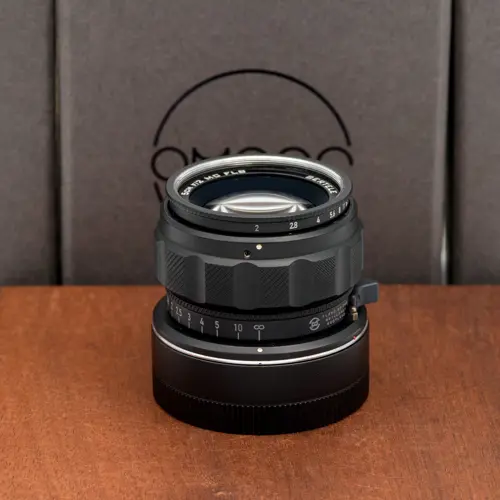
Omnar Bertele 5cm f/2 MC FLB
M mount
No listings tracked for this lens right now.
The Omnar Bertele 5cm f/2 MC FLB is a M-mount lens for Leica rangefinder cameras. Leica price index →
How it compares
Measured against the 76 other 50mm M-mount lenses in the catalogue.
Specification
About this lens
Omnar Bertele 5cm f/2 MC FLB
What makes the Omnar Bertele 5cm f/2 MC FLB unusual is not its optical formula, which dates to 1934, but the mechanics built around it. The lens is a modern recreation of the classic 5cm f/2 Jena six elements in three groups lens formula designed by Dr. Ludwig Bertele. It is the work of Omnar Lenses, a small UK boutique, and represents that maker's first lens built with newly sourced glass rather than rehoused optics from compact cameras [3]. Omnar Lenses was founded by Hamish Gill of 35mmc and Chris Andreyo of Skyllaney Opto-Mechanics, and is a VAT registered UK Limited Company with its head office in Worcester, England. Its manufacturing workshop and operational headquarters are in Alexandria, Scotland, where Skyllaney Opto-Mechanics operates as the primary manufacturer for Omnar Lenses.
The defining feature is the Floating Lens Block, abbreviated FLB. The original 5cm f/2 and f/1.5 versions of Bertele's Jena formulas suffered from focus shift in the mid aperture ranges, an effect Omnar attributes to changes in the effective focal length as the iris closed down. The Bertele lens uses the FLB system to counteract the formula's effective focal length recompilation, keeping the focal plane where the rangefinder patch focuses across the full f/2 through f/22 aperture range. A second, lesser-known shift appeared at close distances. Classic LTM versions of the formula were often limited to a 1-meter minimum focus distance because their linear rangefinder cams could not cope with the sub-1-meter behavior, whereas the Bertele addresses this with a pre-loaded, reverse-sloped, non-linear rangefinder cam, something the maker states is possible using the M mount but not the LTM mount. The result is a rangefinder-coupled lens that focuses accurately down to 0.7 m. Built around an all-brass helicoid, the lens carries 39 mm filters and weighs 260 g, projecting about 35 mm from the camera body.
The lens is designed and hand assembled in the UK and offered in limited batches with customization options[5]. In one review the version tested came with a black Cerakote finish that will show brassing as it wears, and it can also be purchased with a chrome finish, with a degree of customization available to order. Beyond the 35 mm full-frame format, Omnar states the lens is designed for full sensor coverage on 44 by 33 mm digital medium format sensors such as the Hasselblad XCD and Fujifilm GFX series, where it gives vignette-free use and acts as a 42 mm full-frame equivalent thanks to a roughly 62 mm image circle. Pricing places it firmly in boutique territory; these are described as boutique recreations from the UK priced at roughly 3,700 US dollars.
Optical qualities
Rendering The lens aims to keep the look of the original Sonnar-type design while correcting its focusing flaws. It uses modern scratch-resistant, ultrasonically cured, air-bubble-free glass, and replicates the blue and violet multi-coating found on late war-era versions of the formula. Because the original Oberkochen attempt to reduce focus shift used a ninja-star aperture that hurt the out-of-focus rendering, Omnar states the FLB system meant such an aperture was not necessary, so the Bertele achieves the same bokeh qualities as the classic Jena version.
Sharpness and contrast Reviewers found the modernized optics deliver strong results. One review noted that the modern improvements make the lens very sharp and very contrasty.
Bokeh and transitions The out-of-focus rendering follows classic Sonnar behavior. One reviewer observed that Sonnar lenses show bokeh that differs significantly between maximum aperture and stopping down by at least one stop, which is also the case here.
Flare resistance Flare control is better than the vintage lineage might suggest. One reviewer noted that while a vintage lens would normally be expected to have poor flare characteristics, the Bertele 5cm handles bright light sources surprisingly well. This is consistent with the Sonnar layout, since an advantage of Sonnar lenses was higher contrast and better flare resistance at wider apertures, due to their low number of air-to-glass surfaces.
Distortion and vignetting Vignetting is modest. Measured light falloff was about 2.0 EV at f/2.0, 1.2 EV at f/2.8, and 1.0 EV from f/4.0 through f/22, with the wide-open figure roughly 0.5 EV lower than most 50mm f/2 M-mount lenses tested.
Aberrations Color fringing is well controlled. One reviewer reported that lateral chromatic aberration is on a minimal level and nothing to worry about.
Focus shift The central design claim was borne out in testing. One reviewer concluded that from their tests, the focus shift has been successfully mitigated by this new design.
Collector and user notes This is a specialist purchase. One reviewer suggested it suits a buyer who is a huge fan of the Sonnar rendering and relies solely on the rangefinder to focus, perhaps because they only shoot film, to fully appreciate the floating lens block design and its lack of focus shift.
History
Development and Launch The lens revives a formula nearly a century old. Omnar spent five years researching, developing, designing, and engineering the lens, recreating a 1934 Sonnar-type design while addressing its known weaknesses. The shared enthusiasm for this formula is how Gill and Andreyo first met in 2020; under the Omnar brand they had previously offered rehoused lenses from compact cameras, making this 50mm f/2 Bertele FLB a novelty as their first lens with newly sourced glass elements. It was announced in 2025 and produced in limited pre-order batches.
Production Evolution Omnar intends the underlying technology to spread beyond this single product. The company describes the FLB system as one of the biggest advancements to rangefinder lens design since ASPH and FLE lenses, with the potential to resolve focus shift on other formulas. To that end, Omnar has chosen to release the schematics and design of how the FLB system works so that other lens designers and manufacturers can implement it.
Special editions No major factory special variants are widely documented beyond the standard finish and customization options. The lens is offered in different finishes, with one reviewer noting both Cerakote and chrome versions and a degree of customization to order [1].
Collector Notes Because the rear of the lens can support six-bit coding, buyers should not assume it ships coded; one reviewer noted that the rear of the lens has grooves that can be painted to enable 6-bit coding. Note also that a quirk of the FLB mechanism affects bench testing: one reviewer explained that because of the lens's mechanical design, changing the aperture value automatically changes the focus setting as well. Buyers should confirm finish, customization, and batch details directly with the maker, as supply has been limited to numbered pre-order batches.
Sources
- PetaPixel. Omnar Bertele 5cm f/2 Review: It Should Not Look This Goodpetapixel.com →
- PetaPixel. Revolutionary Omnar Bertele 50mm f/2 MC FLB Lens Recreates a Classicpetapixel.com →
- Phillip Reeve (Bastian Kratzke). Review: Omnar 50mm 2.0 Bertele FLBphillipreeve.net →
- Omnar Lenses. Omnar Lenses FAQomnarlenses.com →
- Omnar Lenses. Omnar Bertele 5cm f/2 MC FLBomnarlenses.com →
Where to buy
Related lenses
Similar lenses you might be interested in
Comments